





If you live or work abroad and have finally made the decision to move to Japan to study the language and build a new life here, your first month here can be terrifying. After all, you need to do different procedures, from opening a bank account to registering your address, and getting your health insurance. However, once you get through that month, you’ll find yourself enjoying life in Japan for as long as you plan to stay there. But now the question is, how do you move to Japan, and how do you survive your first month in Japan? Fret not, we have you covered.
In this guide, we’ll break down your first month into weeks, which include all the procedures that you’re going to do within that week. Don’t worry, moving to Japan is not as hard as it sounds (if you follow our guide, of course).
Want to study Japanese with us?
Before you arrive in Japan
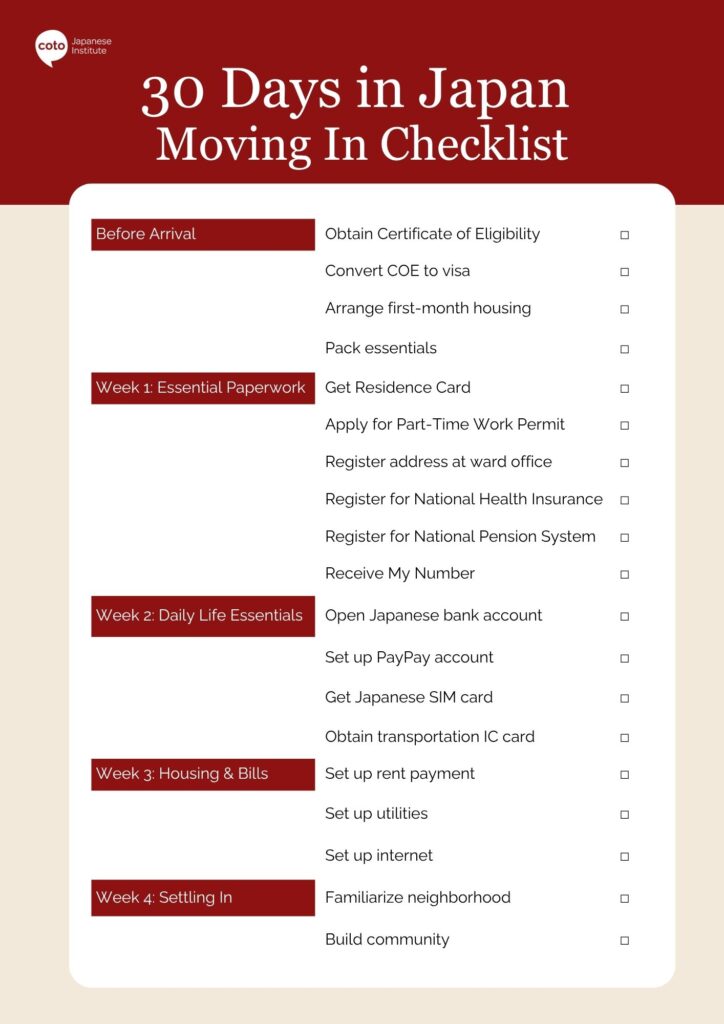
1. Visa preparations
Before you begin to make preparations to move to Japan, you need to secure a visa. For prospective student visa holders, you will need to satisfy the 150-hour Japanese study requirement, which can be satisfied by providing a certificate of completion from an educational institution, such as a high school, university, or Japanese language school in your home country. Applying for a new Certificate of Eligibility, or COE, takes about one to three months.
If you manage to get a Certificate of Eligibility, take it to your local Japanese Embassy or Consulate in your country to get it converted into a visa. Remember to bring your passport (with at least six months’ validity), a recent, good-quality portrait photo of yourself, school guarantor information (if you’re planning to enter on a student visa), and any documents required by the Embassy or Consulate, such as a visa application. Enter Japan within three months, starting from the day your Certificate of Eligibility was issued.
2. Housing arrangements for your first month in Japan

While you might consider staying at a hotel for the first few days after you move to Japan, you’ll need to find accommodation as soon as possible. Here are a few options for you when it comes to finding accommodation.
Sharehouses
Sharehouses are a great option for those who like to meet new people in their first month in Japan. As the name implies, whilst you will have your own private room, you will be sharing a house with a mix of Japanese and international roommates. Shared facilities include the kitchen, bathroom, and a common room. If you want to make new friends immediately upon your arrival, this cost-friendly option might be best for you.
| Cost | Approx. 50,000~80,000 yen per month |
| Facilities | Private bedroom, shared kitchen, living room, bathroom. High-speed internet is usually included. |
| Location | Various locations |
| Recommended for: | For those wanting to save money whilst making new connections in Japan. |
Homestay
Staying with a host family can be a great option if you want to fully immerse yourself in the Japanese language. Like sharehouses, you will have your own private room, but meals will be provided by the family. Being part of a host family will allow you to experience daily life in Japan, as well as connect with Japanese people.
| Cost | Approx. 70,000~90,000 yen/month |
| Facilities | Private bedroom. Shared living room and bathroom. Meals (usually breakfast and dinner) are included. |
| Location | Varies from family to family |
| Recommended for: | Great for those who want maximum exposure to the Japanese language, as well as making new connections with Japanese people. |
Private apartment
Finally, if you’re the type of person to want their own privacy, staying in your own apartment can be a great option. Living in your own apartment has its own perks; you will have your own room, kitchen, and bathroom, in addition to being conveniently located in the central city areas. There are some apartments that are already furnished, which can save you the cost of buying new furniture and supplies.
However, it can be difficult to find an apartment in Tokyo, especially if you don’t speak Japanese. Don’t worry, companies such as Oak House and Wagaya can help you find an apartment before your arrival in Japan.
| Cost | Approximately 80,000~130,000 yen per month, depending on where you’re staying |
| Facilities | Bedroom, living area (for some apartments), kitchenette, bathroom |
| Location | Central areas, some within walking distance of the school. |
| Recommended for: | For those who need more privacy and a quiet living environment to study. |
Ready to study Japanese and move to Japan? If you choose to study at Coto Japanese Institute, we’ll support you in all aspects of Japanese life, including housing and visa support!
What to pack for the first month in Japan
Before you fly to Japan, be sure to bring the following:
- Your passport
- Your Certificate of Eligibility, as you will need it for your Residence Card
- Clothes and shoes that correspond to the seasons in Japan; for example, light jackets and sweaters if you’re arriving in the autumn.
- Some toiletries
- Medication for at least one month, if needed (if you’re bringing in more than one month’s supply of medication, then you will need to apply for an Import Confirmation Certificate, or Yunyu Kakunin-sho (輸入確認書).)
- A travel adapter is especially useful since Japanese plugs are different from those in your home country.
- Souvenirs, or omiyage (お土産), if you’re staying with a host family.
We recommend that you pack light when you move to Japan. It might be tempting to bring all of your personal belongings with you on your flight, but unless you’re planning to stay in Japan long-term (even after you’ve completed your Japanese studies), we don’t recommend bringing everything with you to save luggage space.
Week 1: Essential Paperwork
You’ve said goodbye to friends and family that you will leave behind. You’re now on a plane bound for Japan, marking the beginning of a new chapter of your life. While the move to Japan can be exciting, there are several procedures that you will need to complete when you arrive in Japan, which we will explain below.
1. Getting your Residence Card at the airport
After a long flight, you’ve finally arrived in Japan! The first thing you need to do once you arrive is to get your Residence Card. Having a Residence Card is essential for most procedures when you’re settling into your new life in Japan.
The process of getting your Residence Card is simple; just go to the immigration counter and present your passport and your Certificate of Eligibility. Your visa status will be verified, and your Residence Card will be issued on the spot. However, do make sure to check that the information on your Residence Card is correct, such as your name, nationality, residence status, and period of stay.
If you want to work a part-time job while you’re in Japan, make sure that you fill out the Part-Time Work Permit form, or Permission to Engage in Other Activities form, before your arrival. You will receive the work permit immediately upon presenting this form at immigration.
While you are in Japan, you are required by law to carry your Residence Card with you at all times. Failing to do so can result in stiff penalties.
2. Registering your address
Once you get your Residence Card at the airport, you must now register your address at the local ward office, or kuyakusho (区役所), within two weeks of receiving it. Bring your passport, Residence Card, and your Japanese address written on a piece of paper (ideally, where your accommodation is).
Once you register your address, it will be recorded on the back of your Residence Card. You will then have access to a range of services that the ward office has to offer, such as registering for National Health Insurance or registering for a My Number Card.
3. Registering for National Health Insurance (NHI)
Japan has a universal healthcare system, which means that enrollment in National Health Insurance is mandatory for all residents. It covers 70 percent of your medical costs, which means that you only need to pay 30 percent of the remaining costs.
After arriving in Japan, make sure to register for NHI at your local ward office at the National Health Insurance Counter, or the Kokumin Kenko Hoken-ka (国民健康保健課). Ideally, you’ll want to complete this procedure on the same day you register your address at the ward office. You will receive a health insurance card that is presented whenever you visit a doctor’s office.
If you do not have health insurance yet, you can still receive healthcare services in Japan and be reimbursed later.
4. Registering for the National Pension System
By Japanese law, all residents aged 20 to 59 must join the National Pension system. The National Pension system supports Japanese society, such as people living on disability, people who are old in age, and families whose primary money earner has passed away.
Complete the registration within two weeks of your arrival in Japan (or within two weeks of your 20th birthday) at the National Pension counter, or Nenkin-madoguchi (年金窓口). However, if you are a student, then you can ask to postpone your payment. Ask for “Gakusei Nofu Tokurei” at the counter and fill out the given form.
5. Receiving your My Number
Within two to three weeks of registering your address in Japan, you should receive a 12-digit identification number known as a “My Number” (マイナンバー). This number is used across tax, social insurance, and administrative systems in Japan.
You don’t really need a My Number Card to start out your life in Japan, though it can be useful for various things, such as verifying your identity at banks and government offices, accessing online government services, or filing tax returns electronically. What matters is that you have the number itself, as you will need the number for opening a bank account, signing a part-time job contract, and tax and administrative procedures.
While it is optional, if you register for a physical My Number Card at the ward office, you’ll also have to register your Health Insurance Card, which can be used as your official insurance card.
Week 2: Setting up your daily life
Moving to Japan also involves settling into your new life. Now that you’ve received your Residence Card and completed all ward office procedures, you’ll need to set up a Japanese bank account, SIM card, and transportation card. The procedures to get them might be daunting, but don’t worry, we’ll explain how to get these set up within your second week of being in Japan.
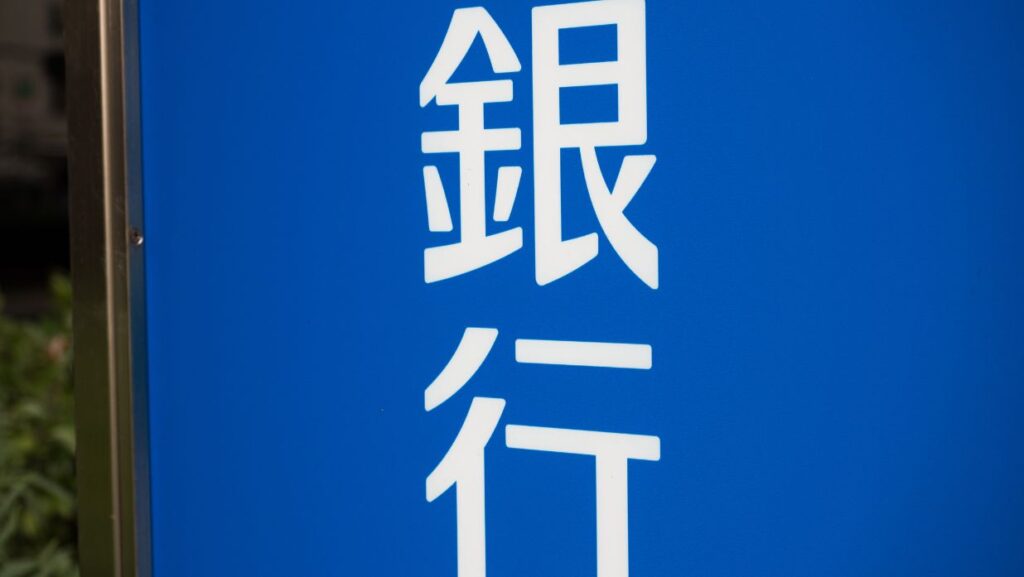
1. Setting up your bank account
You’re going to need a Japanese bank account to settle your living expenses, pay your rent, and receive payments if you plan to work in Japan. Generally, you will need your Residence Card, passport, proof of address, and a personal seal (inkan) to open a bank account. For students, you will also need a student enrollment certificate. Some banks might even require you to have a My Number notification to open an account.
Please note that some banks require you to be a resident of Japan for six months before you’re allowed to open a bank account with them with full services, which includes online banking and debit cards.
A bank we recommend international residents to use is Japan Post Bank, or Yucho Ginkou (ゆうちょ銀行), since their requirements for opening a bank account tend to be more accessible compared to other banks. They don’t require you to be a resident in Japan for six months, and some branches have English support. Another option that we recommend is Resona Bank (りそな銀行). Like Japan Post Bank, it doesn’t require new customers to be residents of Japan for six months.
If you can’t open a bank account right away, you can also use cashless options such as PayPay for everyday payments in the meantime. PayPay is a popular cashless payment app that is widely used in Japan.
To set up a PayPay account:
- Download the PayPay app on the App Store (for iOS) or the Google Play Store (for Android). (Note: the PayPay app might not be available in your country. If that’s the case, change your app store region to Japan.)
- Sign up for an account by registering your phone number and creating a password.
- Add money to your PayPay account. You can do this by either:
- Connecting your bank account to your PayPay account, but you will need your ID for verification. This is a convenient way for you to add money to your account.
- Adding cash funds at a convenience store.
- Using your credit card (limited to Visa or Mastercard).
2. Setting up your Japanese SIM Card
You’re also going to need a Japanese phone number for many things, such as making reservations, using two-factor authentication, and even making some online purchases. To get a SIM card, all you need is your Residence Card, a Japanese bank account or credit card, and a SIM-unlocked phone. Some options for SIM cards include:
- Buying SIM cards from major carriers: The three major carriers in Japan are Softbank, au, and docomo. They offer full services at a higher cost.
- Budget carriers: Carriers such as LINEMO and Aeon Mobile offer lower-cost, data-focused plans. Perfect for those on a budget.
- Prepaid SIM cards: This is a good short-term, non-contracted option that is offered at airports and electronic stores.
3. Buying a Transportation IC Card
While you can just buy train tickets at the ticket machine, it’s an inconvenient way to use Japan’s public transport system. It’s strongly recommended that you get an IC card, which is a rechargeable prepaid card used all around Japan. You can use them in lieu of train tickets or cash. Beyond public transportation, IC cards can also be used at convenience stores, vending machines, and many shops and restaurants that take cashless payments.
Read more: Guide to Japanese Convenience Store
In Tokyo, the main providers of IC cards are SUICA and PASMO. Currently, physical cards have limited availability, but there are mobile versions available that work just the same as their physical counterparts.
To obtain a physical IC card, visit the ticket machines at any train station or at the station service counters. If you choose to opt for the mobile version, you can set up an IC card through the Suica or PASMO app. Likewise, if you decide to change from physical cards to mobile cards, you can transfer the physical card to your phone.
Additionally, we also recommend getting a commuter pass, or teikiken (定期券), to save up on travel costs. A commuter pass will cover the cost of travel between the closest home station and the nearest station where you work or study. In addition, any station you get off in between those two stations will not incur any cost as long as the commuter pass is valid.
To get a commuter pass, you can get it at the ticket machine. You can choose between a one-month, three-month, or six-month pass. Alternatively, you can go to any station ticketing office to ask for a commuter pass. If you’re a student, you can get a discount on commuter passes; just go to the station ticketing office and present your student ID at the counter.
Week 3: Housing and Bills
Now that you have your bank account, SIM card, and transportation card set up, you will need to find a way to set up monthly payments, such as rent and utilities, especially if you’re living in your own apartment. Here are some of the things you’ll need to do:
1. Setting up payment for rent
For apartment contracts, you should have already paid the security deposit, or shikikin (敷金), as well as any key money, or reikin (礼金), if applicable. In addition to your rent, you will also need to pay maintenance fees, or kanrihi (管理費). As stated in your rental contract, it should tell you when you need to pay your rent. Failing to pay your rent on time can result in late fees or worse, eviction.
Though there are many ways to pay your rent in Japan, we recommend setting up automatic withdrawals with your Japanese bank account to pay your monthly rent. This will save you time on transferring the money directly. To do so, you can apply for a direct debit service when you first sign the contract for your apartment.
2. Setting up utilities
If you’re living in a sharehouse, then utilities are already included in your rent. If you are choosing to live in a private apartment, you will need to pay for utilities by yourself. Since the liberalization of the energy market, you can choose from a variety of providers to set up your utilities. For electricity and gas, we recommend getting set up with major local providers such as TEPCO and Tokyo Gas, respectively. Some companies may offer bundled plans that provide both electricity and gas, which can simplify the process of paying your bills and can be a money saver. For water, you must use the official provider for your specific area, since it’s managed by the Bureau of Waterworks.
About a week before moving into your new place, contact your providers to get your utilities set up, either online or by phone. For electricity and water, you can use them immediately after turning on the breaker or tap, but you will need to register your details immediately. For gas, schedule an appointment for a representative to turn on the valve for safety reasons. You must be present at home to do so.
As for payment methods, you can either:
- Pay at the convenience store by bringing your monthly paper bills to the counter
- Set up automatic bank withdrawals for a “hands-off” experience
- Use your credit card to pay online.
Setting up your internet
If you’re living in a place where the internet isn’t provided, then you’re going to need to set it up yourself. The three major mobile carriers, au, docomo, and Softbank all provide various options that suit your needs when it comes to internet access. Fiber optic internet is a popular and reliable option if you want high-speed internet. Check your options to see what is available.
To apply for an internet plan, bring your Residence Card for identity verification. You might also want to bring your passport and My Number Card just in case. In addition, you need to have your Japanese bank account details or credit card details in order to make payments.
Week 4: Settling in
Now that you have your rent, utilities, and internet set up, you’re almost done! You might have taken care of the bureaucratic stuff, but now for the hardest challenge: settling into your new surroundings. Living in a foreign country, especially in Japan, can be tough, but you can make your life in Japan easier by doing the following:
1. Familiarizing your surroundings
It’s important to familiarize yourself with your surroundings in the neighborhood that you are staying in, as these landmarks might be useful to you in the future when you least expect them. Check the map of your neighborhood to see where these landmarks are for future reference. For example, you can check the map for the following:
- The nearest police box, or kouban (交番)
- Evacuation centers, in the event of a major natural disaster
- Train stations
You will also need to know where the nearest hospitals or clinics are for future reference. It might also be useful to find out where your home country’s embassy or consulate is, just in case.
2. Finding community in Japan
Your first month in Japan can be daunting, especially since you’ve left all of your friends and family behind in your home country. Especially for those whose Japanese might not be at a daily conversational level, it can be hard to find community because of potential language and cultural barriers. We encourage you to find meetups online specifically for international residents or students. It can also help to find groups or organizations that are specifically targeted towards people from your home country. Language exchange groups are also a great way to meet people, as well as practice your Japanese.
Emergency Numbers in Japan
The most important numbers you’ll need to remember in Japan are:
| Number | Purpose | Notes |
| 119 | Ambulance and Fire | For medical emergencies or fire |
| 110 | Police | For accidents, crimes, or safety concerns |
| #9110 | Police consultation | For non-emergency situations |
| 171 | Disaster message service | Record or listen to messages during natural disasters |
| #7119 | Health advice line | For non-emergency medical consultations (available in some regions) |
Do you need Japanese to survive your first month?
Technically, you can survive your first month in Japan with basic Japanese, but it might be beneficial for you to learn the language to get through any procedures that you need to complete when you arrive. You may consider asking a Japanese friend to help you with the necessary procedures, such as those that need to be completed at the ward office or with signing rental contracts for your apartment.
Final checklist for your move to Japan
Now that you have read our guide to surviving your first month in Japan, it’s time to do a final check on what you need to do before you leave your home country. Have you:
- Obtained a Certificate of Eligibility and converted that into a visa?
- Packed the essentials, including your passport?
- Arranged for accommodation when you arrive in Japan?
Have you checked all the above? If so, then you’re ready to move to Japan! Good luck, and all the best in moving!
Ready to move to Japan? Study with us!
If you are still considering your options, why not study Japanese full-time in Tokyo with Coto Japanese Institute? You’ll be able to learn Japanese with the best teachers, in modern, state-of-the-art facilities in Kokubunji. While we offer short-term courses, we recommend that you take the long-term courses to ensure that you sustain your learning progress.
Ready to start your language learning journey, or need more information on Coto Japanese Institute?
Ready to apply? Submit your application to secure your spot for our 2027 intakes!
Have questions? We can provide information on our visa-eligible programs, housing, and career support. Reach out to our team to get started!
FAQ
What are some external resources I can contact in Japan?
For visa-related issues, such as residence procedures and visa status, we recommend contacting the Immigration Services Agency. For consultations on daily life in Japan, contact the Foreign Residents Support Center (FRESC).
I need a translation at the hospital or clinic. Is there an interpretation service available?
You can contact NTT Medical Interpretation for telephone interpretation at hospitals or clinics. If you don’t want to use an interpretation service, you can bring someone who knows Japanese with you to the hospital or clinic.
What documents do I need to move to Japan?
You’ll typically need a valid passport, a visa (work, student, or spouse), and, in some cases, a Certificate of Eligibility. Make sure to also have your housing and employment details ready for visa processing.
How do I find housing in Japan?
Most foreigners start with real estate agencies specializing in expat rentals or online platforms. Apartments often require key money, deposit, and guarantor. Tokyo and Osaka have more options, while smaller cities may require Japanese language support.
What should I do in my first 30 days in Japan?
Focus on registering your residence at the city hall, opening a bank account, getting a SIM card, signing up for health insurance, and familiarizing yourself with local transportation and stores.