





Some of us might not know that Japan’s hiring process for graduates is very different compared to most countries. This is mainly because Japanese companies tend to still adopt a bulk-hiring system, where new hires start on the same day.
According to the Japan Student Services Organization, or JASSO for short, Japan’s new graduate hiring process usually begins around March and ends around October.
For new graduates, the job hunting process tends to begin earlier than that. Some of us start to research the companies we want to work for, one or even two years before we even start the process. But now that you have decided to start a career in Japan, how do you navigate Japan’s unique system of new graduate recruitment?
If you find yourself applying for a company that follows the traditional hiring process, we’ve created this guide to walk you through the steps of going through the new graduate hiring process in Japan. We’ll also talk about how Japan’s hiring practices are different from Western hiring practices and the difficulties you might face as a foreign new graduate.
Want to study Japanese with us?
Overview of Japan’s new graduate hiring system
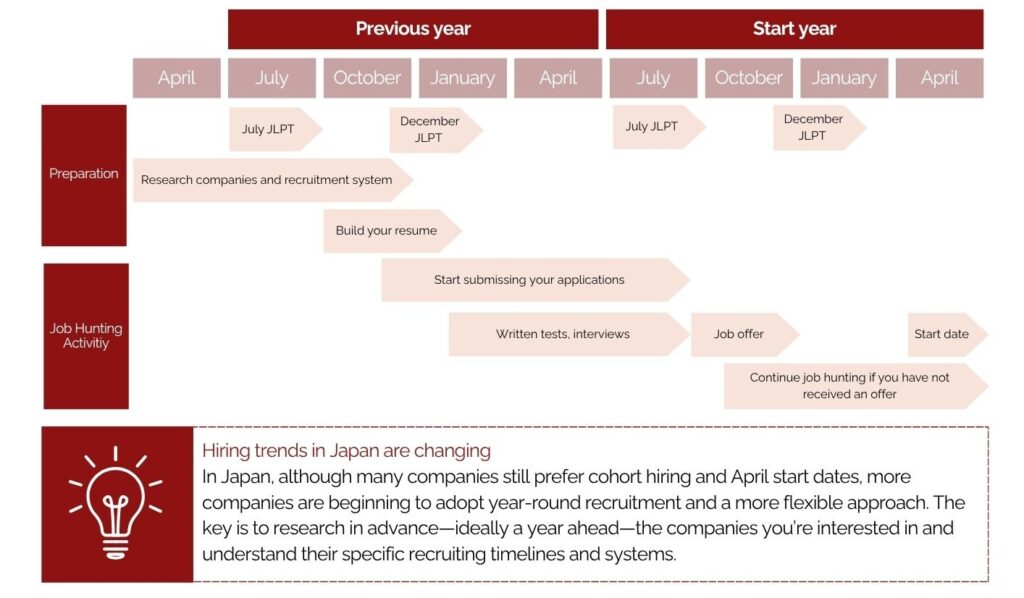
Japan’s annual new graduate hiring system is known as shinsotsu saiyo (新卒採用), and the job-hunting process that students go through is called shushoku katsudo (就職活動), or shuikatsu (就活) for short. These positions are typically seishain (正社員) roles, meaning permanent, full-membership employment at a company.
The job hunting season in Japan begins about a year before graduation, which for most Japanese universities falls at the end of March. While some companies will consider past graduates (kisotsu, 既卒) or recent ones (daini shinsotsu, 第二新卒), large companies’ shinsotsu programs are primarily aimed at current students.
While there is no definitive timeline, the job-hunting guidelines requested by the government to organizations such as Keidanren (Japan Business Federation) state that recruitment marketing can only begin in March of the year before students graduate, formal recruitment activities should start in June, and official job offers are made in October.
For example, companies that want to have their graduates start in April 2026 should start marketing job listings in March 2025, do screenings and interviews in June, and issue an unofficial job offer called naitei (内定) in October.
If you’re thinking about studying Japanese in Japan, join the Coto Institute. Alongside your language studies, you’ll get hands-on career support: resume guidance, interview preparation, and one-on-one counselling to help you find your footing in Japan’s job market.
Key differences between Japanese hiring processes and Western hiring processes
As you can already tell, hiring practices in Japan very different from Western hiring practices. Below is a table that summarizes what companies are looking for in Japan as compared to their Western counterparts:
| Japanese Hiring Practices | Western Hiring Practices | |
| How many interview rounds? | Many interview rounds | Few interview rounds, usually they would have one or two |
| What are recruiters looking for? | Candidates who have potential (through on-the-job training), and can commit to the company long term Candidates who can collaborate with others and are risk-averse | Candidates who have the skills necessary to perform all tasks as described on the job listing Candidates who are willing to take risks to better the company |
| Group-based hiring or individual hiring? | Group-based hiring, traditionally, within a certain time period | Individual hiring, all year round. |
| Are there SPI tests? | Yes (for most Japanese companies) | No |
You can read more about how Japanese work culture is different from Western work culture.
Step 1: The entry sheet
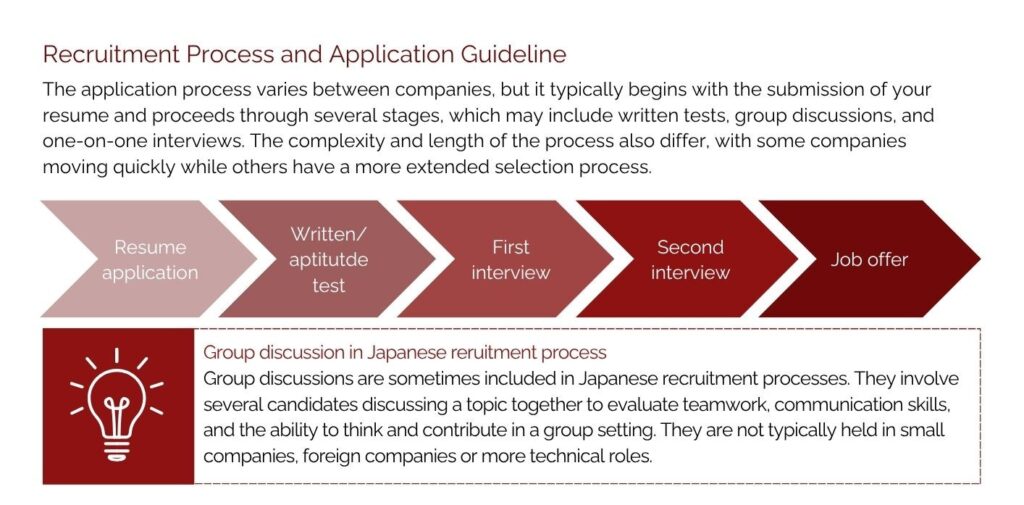
You’ve collected the information about the companies you want to apply for. You’ve attended every company information session, or kaisha setsumeikai (会社説明会). Now you’re ready to start applying to the companies you want to work for. Time to fill out an entry sheet!
What is an entry sheet?
You might be wondering, “What is an entry sheet? Well, this is the start of any job application in Japan. This is a document where you will highlight your educational background, your strengths, and motivations to work for a specific company. Usually, you would handwrite these entry sheets, though recently, it’s become more common to send the entry sheets online.
A typical entry sheet will consist of:
- Your personal details, such as your name, address, email, and phone number
- Your educational background, and any relevant work experience, if necessary
- A professional photograph of you in a suit. If you’re handwriting your entry sheet, make sure to include information pertaining to your school and department, as well as your full name, on the back of the photograph.
- Any certifications or licences that you have obtained in Japan or your home country.
Common questions on a Japanese entry sheet
The questions you will find on your entry sheet might differ from company to company. Some common questions that you might find on a Japanese entry sheet include:
1. The Self-Introduction
This is called the jiko PR (自己PR), and this is the section where you write down your strengths, and also how your strengths can benefit the company. We recommend that you pick one past experience where you got to showcase your strengths and connect that to how you would benefit the company with said strengths.
2. Motivation to join the company
Another common question that you might find on an entry sheet is your motivation to join the company, or shibou douki (志望動機). For this particular question, it’s pretty straightforward; write down why you want to apply for that specific company, and what skill sets you can contribute to the company’s success.
3. Reason why you want to work in Japan
This question might appear on your entry sheet for foreign graduates. Just answer why you want to work in Japan and what your motivation is for working in Japan. This is to determine whether you would adjust well to the Japanese work environment, as well as whether you want to pursue a long-term career in Japan.
4. Other questions
Some other questions that might appear in your entry sheet include academic achievements, hobbies, or even your weaknesses, and how you learned from the experience. Again, entry sheet questions might differ from company to company, so be sure to check carefully.
How is this related to the initial screening process?
Especially since companies will receive a large number of applications, recruiters will screen every single entry sheet to not only learn about the traits and educational history of candidates, but also see which candidate will have the potential to benefit the company. A majority of candidates don’t make it past this stage, so it’s important that you write each entry sheet to the best of your ability and stand out from other candidates.
Step 2: Aptitude Tests
If you managed to pass the entry sheet stage, then chances are that you’re going to need to take an aptitude test, or tekisei kensa (適性検査). These tests will determine whether you have the core competencies, decision-making, and so forth for the company that you want to work for, especially if it’s for a major Japanese company. These tests are usually paper-based, but recently, web-based testing has become more popular.
What you will be tested on
Most aptitude tests, such as the SPI (Synthetic Personality Inventory), will test you on your verbal and nonverbal skills. These skills can include Japanese language skills, reading comprehension, logic, math, and personality tests. The language skills and mathematical questions tend to be bundled up into one section, with the next section being the personality test.
Especially for the personality test, the aim of having SPI tests is to measure your abilities as an employee, as well as your overall personality, and whether you would be able to fit into the company culture. To prepare for an SPI test, if there’s any, it’s best to study for it. There are various resources for you to study for an SPI test as well.
Other tests
Some aptitude tests require candidates to write an essay on a specific topic. These tests will measure your ability to think critically, creativity, and information gathering abilities.
Step 3: Group Discussions
Some companies will have candidates go through this stage. These group discussions will have at least four to six other candidates, including yourself, with one interviewer supervising the group discussion. The task assigned to you can differ from company to company; for example, one company might ask you to present a new idea for a marketing campaign, while others might ask you to present a story.
Because this is a group discussion, remember that the opinion of others matters too. The point is to divide yourselves into different roles, such as note-taker, presenter, moderator, etc. Group discussions are held to test your ability to work in a team, as well as your leadership skills, if any, in addition to your communication skills. This is because in Japan, they value teamwork over individual decision-making.
Step 4: Multiple Interview Rounds

If you manage to get through the group discussion, then you’ll be able to move on to the most daunting part of the hiring process: the interview stage. While some interviews are conducted online, chances are that you might have to attend an in-person interview.
Make sure to dress appropriately, learn the basic interview etiquette, and stay calm during each interview!
Read more: Most common Japanese job interview questions.
The First Interview: Casual Screening
The first one-on-one interview in the graduate hiring process in Japan just a casual screening and will focus mainly on your personality, your motivations for working in Japan, and why you want to work in Japan. Of course, you’re also going to want to do a short self-introduction during this interview as well. This interview is always short, usually around 20 minutes.
The Second Interview: Deeper evaluation
If you pass the casual screening, you will be invited to the second interview, if there is any. This interview stage will be a deeper evaluation into your motivation to join the company, as well as whether you’ll be a cultural fit.
The Final Interview
If you somehow managed to get through both interview stages, then be prepared for the final interview. This is usually held at the executive level, so expect to see high-level employees at this interview. According to some candidates, this interview is known as the appaku mensetsu (圧迫面接), or “pressure interview.” While this interview is meant to measure your commitment and long-term potential at the company, this interview will also measure how well an interviewee can deal with stressful situations.
Step 5: The Job Offer
You’ve submitted your entry sheet. You’ve gotten through the aptitude tests and the group discussions. You even managed to hold your own during the interview process. And after all your hard work, congratulations! You got an offer from the company!
But hold on, before you celebrate, there are some things you’ll have to consider, from receiving a “nainaitei” (内々定) to actually getting hired.
What is a naitei (内定), and why is it not always a final contract?
In the graduate hiring process in Japan, naitei is basically a written document that guarantees that you will be hired at the start of April, which is the start of Japan’s fiscal year. Usually, before you get the naitei, you will receive a nainaitei (内々定), which is a notification that you have passed the company selection. Sometimes, there’s even a company naitei shiki (内定式), which is a ceremony that celebrates candidates who have passed the new graduate recruitment at that company, where they will receive a naitei.
Just because you received a naitei doesn’t mean that you have to work for that company, especially if you have received multiple job offers. The naitei, despite it being a guarantee that you will be hired in April, doesn’t mean that you are now bound to the company forever. You can turn down a job offer at a company over the phone, and you are not obliged to give a reason for turning down the job offer.
The acceptance process
Should you choose to accept a job offer, you will receive a document called a “pledge” or “acknowledgement,” which is basically a document confirming your intent to join a company. Mail that document before the set deadline. Remember, this document isn’t legally binding, and therefore is not an official job offer.
Why does the new graduate hiring process take so long?

Now you might be thinking: why does the new graduate hiring process in Japan take so long? Well, there are multiple reasons why, ranging from risk assessment to cultural mindsets.
1. Companies want to avoid risk
In Japan, most companies aren’t willing to take risks, especially if that risk can pose a credible threat to company stability. Instead, companies prefer to stick to tried and true methods that have brought success. For new graduate recruitment, hiring new candidates who won’t leave the company after a few years will ensure that there are no risks to the well-being of the company. Especially for foreign recruits, they want to be sure that the candidate they’re hiring will commit to the company, so they can have a reason to sponsor a work visa.
2. Companies want candidates with a “lifetime employment” mindset
Because of Japan’s risk-averse culture, it can affect how companies hire new graduates. Companies tend to look for candidates with a “lifetime employment” mindset, as leaving the company after a few years poses a “risk” in terms of stability and trust, as finding a replacement to cover the employee who left can be costly, in both time and resources. Hence, companies will offer new candidates high job stability and extensive training in exchange for company loyalty, that is, staying with the company until retirement.
However, the concept of lifetime employment is showing to be more unsustainable as companies are shifting their focus towards mid-career hiring and allowing for transitions in careers. Younger generations, especially, are looking for work-life balance, as well as the freedom to choose whether to leave the company due to low pay or long hours.
3. Companies are hiring for potential, not skills
Instead of hiring candidates based on what skills they already have, Japanese companies want to hire candidates based on potential. Unlike Western hiring practices, instead of hiring specialists, they want to hire people who will become generalists through on-the-job training.
Challenges for Foreign Applicants in Japan’s New Graduate Hiring Process
Language Barriers in SPI/Interviews
One thing to consider when going through the new graduate hiring process as a foreigner is the language barrier, especially when it comes to SPI tests and interviews. Most of the time, you’re going to find that Japanese companies will hold aptitude tests and interviews in Japanese, and this can result in you failing either stage if your Japanese is not at a business or near-native level. It can be tough finding a job in Japan as a new graduate if your language skills are not up to that level.
Fortunately, that doesn’t mean that all Japanese companies will only hold aptitude tests or interviews solely in Japanese. Some international companies, such as Accenture, will do new graduate hiring in English, so be sure to check which language the company will use for their hiring process.
Understanding unwritten rules
What foreign hires will find hard to understand is the countless unwritten rules of the Japanese workplace, or just Japanese work culture in general. They might have a hard time understanding Japanese hierarchy in the workplace, or certain ways a client must be talked about with others. It can be difficult for foreign graduates to understand these rules, so “reading the air” and immediately getting the context is a skill that needs to be learned in order to understand such rules.
Cultural expectations in interviews
This goes hand in hand with language barriers in the interview process. You’ll be expected to follow a structured, if not rigid, set of rules and etiquette during interviews (such as sitting in a certain way or bowing at a certain angle), which can be a culture shock if you’re used to Western hiring practices. This is something that new foreign graduates need to learn if they want to secure a job at a Japanese company (especially if the company is traditional).
Conclusion
Japan’s new graduate hiring process might seem intimidating and even impossible to get through, but don’t worry, just do your best to make it to the interview stage the moment you submit your entry sheet. If you don’t manage to get a job despite making it to the interview stage, don’t worry, take a break and try again. There’s always going to be countless other jobs out there; just because one door is closed on you, it doesn’t mean all doors will close.
You got this, future graduate. Good luck with your job search, and may you find a job that values you as an employee.
Learn Japanese for your career in Japan!
Want to improve your Japanese for job hunting? Why not consider taking Japanese lessons with Coto Japanese Institute! With over 25 years of practical Japanese instruction, our 1-year language program are tailored for individuals who want to open new career opportunities and land a job in Japan.
We are opening April and October intakes! Get started with your application and fill out our application form below!
FAQ
Where can I find more information on job hunting in Japan?
We recommend that you check out the Job Hunting Guide for International Students, published by the Japan Student Services Organization (JASSO). They have a detailed guide on how to navigate job hunting in Japan.
How do I get a job after graduation?
There’s no guaranteed way to get a job after graduation, as there are some people that are still job hunting post-graduation. Ideally, you’ll want to start job hunting one to two years before graduation. It’s best to prepare early.
Should I handwrite or type my entry sheet?
It depends on the company. If you’re going to handwrite your entry sheet, remember to use a black, non-erasable pen. Using whiteout or correction tape is not allowed, so if you make a mistake, you’ll need to rewrite the entry sheet all over again. We suggest that you write a draft of what you want to write on a separate piece of paper before transferring that to the entry sheet.
What should I wear to a job interview in Japan?
While it depends from company to company, it’s generally recommended that you wear a “recruitment suit,” which is a dark suit that new graduates will wear during information sessions, as well as interviews. For men, wear a tie along with your suit, and for women, wear either dress pants, or a knee-length skirt with skin-colored stockings. Black shoes are a must!
How can I avoid “black companies” in Japan?
Make sure to research the company, whether it’s about working hours, pay, or even workplace culture. If there are mostly negative reviews regarding the company’s workplace, then there’s a good chance that it’s a black company.
I failed to secure a job offer. Should I give up?
Receiving a rejection is not a measure of your worth as an applicant. If job hunting is really taking up your mental health, we recommend taking a break and trying again. Keep applying, and you’ll eventually find a company that will value your potential and skills.