





It’s no secret that Japan is hiring foreigners more than ever before, so if you want to work in Japan, now is the best time. However, before you pack your bags and catch the first plane here, you need to land a job first, so you’re probably wondering what skills Japanese companies are looking for when hiring foreigners.
So let’s dive into what skills Japanese companies actually care about when they are hiring! Most Japanese companies seek foreigners with certain hard skills, such as language, but soft skills shouldn’t be overlooked. Traditional Japanese companies are all about cultural fit. Although more companies are adopting global mindsets, many companies still stick to a more traditional way of doing things.
Now, let’s get into what Japanese companies are really looking for when they hire foreigners!
Study Japanese at Coto Institute and open doors to a career in Japan!
Top Skills Japanese Companies Seek when Hiring Foreigners
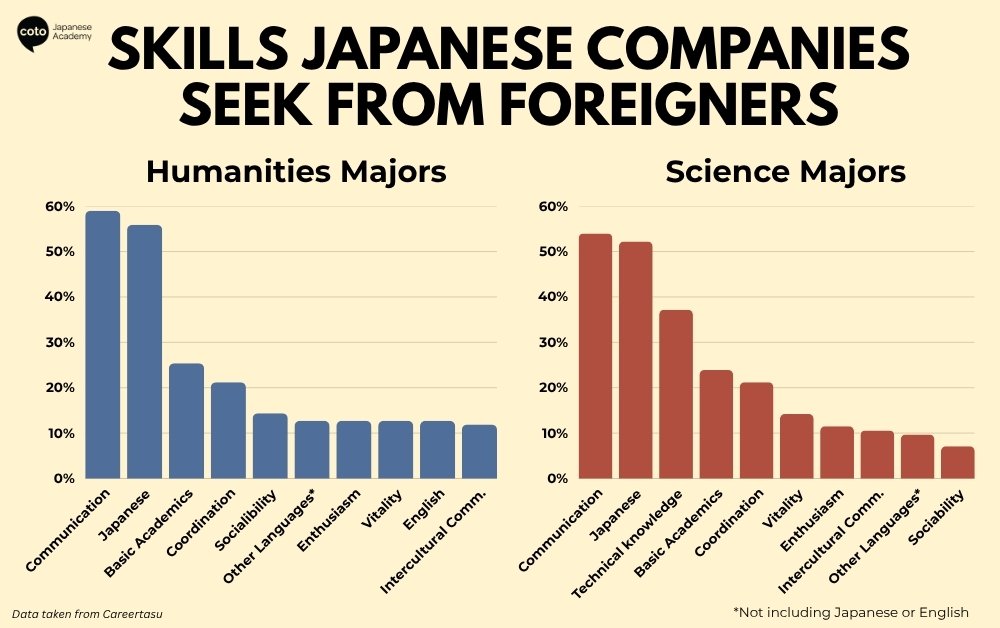
According to a report by Career-tasu, published in December 2024, they successfully surveyed 486 major companies across the nation to answer what skills they look for from foreigners they hire. The survey sought to understand what kind of skills Japanese companies were seeking from foreigners who were graduating from university or graduate school.
The survey also divided foreign graduates into 2 different majors: science majors and humanities majors, in order to see what companies expect from each. Here are the results:
| Humanities Majors | Science Majors | ||
| Communication | 59.3% | Communication | 54% |
| Japanese | 55.9% | Japanese | 52.2% |
| Basic Academics | 25.4% | Technical Knowledge | 37.2% |
| Coordination | 21.2% | Basic Academics | 23.9% |
| Socialility | 14.4% | Coordination | 23.9% |
| Languages other than Japanese or English | 14.4% | Vitality | 14.2% |
| Enthusiasm | 12.7% | Enthusiasm | 11.5% |
| Vitality | 12.7% | Intercultural Communication | 10.6% |
| English | 12.7% | Languages other than Japanese or English | 9.7% |
| Intercultural Communication | 11.9% | Sociability | 7.1% |
Communication and Japanese seem to be the top skills desired for both Humanities and Science Majors. Not too surprisingly, technical skills are more desired for Science Majors, while sociability and foreign languages beyond English and Japanese are more sought after by Humanities Majors. However, it seems that for either major coordination (translated from 協調性, kyouchousei), vitality, and enthusiasm are ranked as most sought after.
So, what do each of these skills mean, especially enthusiasm and vitality, and how much Japanese do you need to know? Let’s break down the top skills needed for both majors.
Read More: What the New Graduate Hiring Process in Japan is Like
Communication & What Japanese is Needed
Communication refers to the ability to speak and present a variety of information to different audiences, so that means both communication and Japanese are interconnected. It makes sense that they are the top two most desired skills by Japanese companies hiring foreign workers. Later in the survey, companies said they struggle most with finding foreigners who can communicate well in Japanese.
The report also found that around 31% of companies seek foreigners who are already at an advanced business level in Japanese before joining, and around 41.5% want foreigners to be at an advanced business level in Japanese after joining. Keep in mind that if your company strictly requires Japanese in the job description, you may need certain language certifications for certain work visas as well. Read our guide for more information: Japan Requires JLPT N2 for Work Visa in 2026 (What We Know)
So, let’s explore what it means to have an advanced business-level of Japanese communication skills.
1. Formal Japanese or 敬語 (Keigo)
Keigo, or formal Japanese, is essential to know when working in a Japanese company since it communicates your respect and gratitude towards different stakeholders, especially those of higher social standing, such as a boss or a client. Keigo mainly consists of different conjugations that either honor the person you’re speaking to or show humility when speaking about yourself.
Kego gets quite tricky since you have to remember different conjugations for the same words. For example, instead of saying する (suru), or to do, in humble keigo form, you would say 致します (itashimasu). Even when writing business emails, you would need to use the proper format and etiquette in order to ensure your message comes across as professional and respectful.
Japanese keigo is just about speaking appropriately to different people, whether it’s your boss, clients, or colleagues working in different departments. A lot of keigo are pretty repetitive phrases that you will say quite often, so to get started on some useful expressions, you can check out our blog: 15 Common Keigo (Business Japanese) Phrases To Know.
However, you should be able to use keigo naturally, being able to communicate and navigate complex business problems in Japanese. So, if you feel you need to practice and drill keigo and business Japanese, you can sign up for a course online (or in-person if you’re in Tokyo/Yokohama)! Click the link below to get started!
2. Japanese Business Etiquette and 根回し (Nemawashi)
Beyond knowing the right words, communication in a Japanese workplace also means understanding the unwritten rules of how business actually gets done. One of the most important concepts to understand here is nemawashi (根回し), which literally means “going around the roots” like carefully preparing the soil before transplanting a tree.
In practice, nemawashi means building consensus before a formal meeting or decision is made. Rather than bringing a new idea cold into a group setting, Japanese professionals will first speak with colleagues and stakeholders individually to get a feel for their opinions and smooth over any potential concerns. By the time the official meeting happens, everyone is already on the same page.
For foreigners used to more direct, debate-driven work cultures, this can feel slow or even unnecessarily roundabout. But understanding nemawashi is essential to being taken seriously as a communicator in Japan. It shows respect for others’ perspectives and avoids the very uncomfortable situation of someone being blindsided or put on the spot in front of the group, something Japanese workplace culture is especially sensitive to.
Here are some practical tips to keep in mind:
Build Relationships
Before pitching a big idea, proposals, or changes, have informal one-on-one conversations with key people to gather early feedback. It’s common and recommended to build healthy business relationships with stakeholders and engage with them on a somewhat informal basis. This allows you to get to know them and understand their actual thoughts on proposals you want to make, allowing you to reach agreements before any of the company meetings.
Read the Room or 空気を読む (Kuuki o Yomu)
In Japanese, there’s an idiom that goes 空気を読み, which translates literally as “read the air” but actually means “read the room.” In order to understand how people actually feel or want, it’s essential to read the room by paying attention to subtle cues. Silence or vague phrases like 「難しいですね」(muzukashii desu ne “that’s difficult…”) usually signal quiet disagreement rather than simple hesitation.
You can also use phrases like ご意見をお聞かせください (go-iken wo okikase kudasai, meaning “please share your thoughts”) to invite input from colleagues in case you’re in the dark about how they feel.
3. Can You Get a Job in Japan with Japanese?
According to the survey, Japanese was the most sought-after skill for companies hiring foreigners. But keep in mind, the total preference for Japanese skills was roughly 50%, and the survey only got responses from 486 companies, so this is truly only part of a whole. While the sample size is significant, the data doesn’t represent all companies in Japan, plus around 50% of companies didn’t rank Japanese as the top priority in the survey itself.
So, it really depends on the role you are aiming for in Japan, as many roles requiring technical skills, such as programming or extensive cultural knowledge to market products in your home country, may not need Japanese, or at least high-level skills. Depending on your career path in Japan, prioritizing skills needed in your chosen industry will be more important, in certain cases, than language skills. For example, if your role requires you to focus on back-end website or app development, Japanese language skills might not be as necessary, especially if you don’t need to focus on copywriting anything for the website. If Japanese is a necessary part of a role you want in Japan, Japanese skills should be prioritized along with other skills you will need.
If you want to know more about jobs you can get in Japan without knowing too much Japanese, check out our blog: 12 Jobs You Can Get in Japan That Don’t Require Japanese
Coordination: 協調性 (Kyouchousei)
Coordination, or 協調性 (kyouchousei), ranks high on the list for both majors, and it’s no coincidence. Japanese workplaces are deeply team-oriented, and the ability to work harmoniously within a group is valued just as much as individual talent, sometimes even more so.
Kyouchousei isn’t simply about being a “team player” in the Western sense. It encompasses being attuned to the mood of the group, adjusting your behavior to the needs of the team, and avoiding actions that disrupt collective harmony. In Japan, pushing your own agenda too aggressively at the expense of team cohesion can be a red flag, even if your individual results are impressive.
For foreigners, this is one area that often requires some cultural recalibration. Here’s what kyouchousei looks like day-to-day:
- Lean into “we” over “I.” When presenting results or achievements, framing things as a team effort rather than a solo win tends to land much better.
- Be consistent and dependable. Following through reliably on even small tasks builds the kind of trust that makes you someone others want to work with.
The good news is that Kyouchousei is very learnable. It’s less about changing who you are and more about staying attentive and being willing to adapt.
Vitality バイタリティ (Baitaritii)
Vitality or バイタリティ (baitaritii, a loanword from English) might sound vague, but in the context of Japanese hiring, it refers to your energy, resilience, and the sense that you can handle the real demands of the job without burning out or checking out.
Japanese work culture, while gradually shifting, has traditionally placed a high value on dedication and endurance. Showing vitality signals to an employer that you have the stamina to push through challenging projects, tight deadlines, and, especially for foreigners, the steep learning curve of adapting to a new work culture in a second language.
But note that vitality tends to show up in your track record rather than something you can just claim in an interview. Here are some ways you can show your “vitality.”
- Taking on internships, extracurricular projects, or part-time work alongside your studies demonstrates initiative and drive.
- Being able to talk clearly about setbacks you’ve faced, academically, personally, or professionally, and how you recovered from them is a strong signal.
- Even the job hunt process itself, known as 就活 (shuukatsu) in Japan, is notoriously grueling. Companies notice how candidates carry themselves throughout that process, so showing up prepared and positive each time matters.
In short, vitality is about demonstrating that you have a genuine drive to keep going, especially when things get tough.
Enthusiasm 熱意 (Netsui)
Enthusiasm, or 熱意 (netsui), is closely related to vitality but with a more specific focus: it’s about your genuine passion and motivation for the job, the company, and the industry you’re applying to.
Japanese companies, particularly large ones, invest heavily in training new hires. They often hire for attitude and potential over specific skills, especially at the graduate level. This means a candidate who clearly wants to be there and can articulate why will frequently be favored over someone with a stronger resume but lukewarm motivation.
This comes up most directly in the 志望動機 (shibou douki), or “reason for applying,” which is a cornerstone of almost every Japanese job application. Companies want to know: Why this company? Why this industry? Why now?
Here’s how to genuinely convey netsui:
- Research deeply. Knowing a company’s mission, recent initiatives, and corporate philosophy (会社の理念, kaisha no rinen) shows that your interest goes beyond just needing a job.
- Connect your personal story. Why does this company’s work matter to you specifically? The more concrete and personal, the more convincing.
- Show a consistent thread. If your coursework, part-time experience, or even hobbies connect to the work the company does, highlight that. It makes your enthusiasm feel earned rather than performed.
Netsui is ultimately about authenticity. Japanese hiring managers are experienced at spotting the difference between rehearsed excitement and someone who genuinely wants to contribute. Want to make sure you impress your interviewers? Read our blog: Guide to Japanese Job Interview: Etiquette, Manners & Tips
Hard Skills Companies Look For?
While soft skills dominate the rankings in the Career-tasu survey, hard skills are still very much part of the picture, especially as Japanese companies become more globally competitive and technology-driven. At the end of the day, the skills you will need depend on the role you are applying for; oftentimes, companies care more about technical skills and knowledge than Japanese language abilities. So, here’s a broad overview of the hard skills that tend to give foreign candidates an edge:
1. Technical and IT Skills

For science majors, especially, technical knowledge ranked third at 37.2%, a significant jump compared to humanities majors. This includes programming languages (Python, Java, and C++ are particularly in demand), data analysis, AI and machine learning, and engineering fundamentals. Even for non-technical roles, basic data literacy, understanding how to read data, use spreadsheets, and interpret analytics, is increasingly expected across industries.
2. Business Tools
Proficiency in Microsoft Office tools, particularly Excel and PowerPoint, remains a baseline expectation in most Japanese companies. Excel, in particular, is deeply used in Japanese business operations, often far beyond simple spreadsheets, including complex formulas, pivot tables, and data modeling. PowerPoint presentation skills also matter since internal proposals and client presentations are a regular part of work life. If you are not already confident with these tools, they are well worth practicing before entering the job market.
3. Industry-Specific Knowledge
Depending on the field you’re entering, companies will require specialized knowledge relevant to their sector. Here are some general fields that foreigners often enter, and some skills that often show up on job descriptions for each field.
| Industry | Key Hard Skills |
| Finance & Trading | Financial modeling, accounting fundamentals, market analysis, Excel (advanced), familiarity with financial instruments (stocks, bonds, derivatives), Bloomberg terminal basics |
| Manufacturing | Supply chain management, quality control (QC/Six Sigma), lean manufacturing principles, CAD software, production planning, ERP systems (e.g. SAP) |
| Engineering | CAD/CAM tools (AutoCAD, SolidWorks), project management, technical documentation, knowledge of industry standards and regulations, programming basics (varies by field) |
| Data Science | Python/R, SQL, machine learning frameworks (TensorFlow, PyTorch), data visualization (Tableau, Power BI), statistics, big data tools (Spark, Hadoop) |
| Digital Design & Web Development | HTML/CSS/JavaScript, UI/UX design principles, Figma or Adobe XD, responsive design, CMS platforms (WordPress, Shopify), basic SEO knowledge |
| Creative Field | Adobe Creative Suite (Photoshop, Illustrator, Premiere Pro), copywriting, branding, video production basics, trend research, graphic design (color theory, visual language principles, etc.) |
| Consulting | Data analysis, PowerPoint deck building, business frameworks (MECE, SWOT, Porter’s Five Forces), research synthesis, financial literacy, project management |
So, if you’re thinking of entering any of the above fields, building your abilities and knowledge in some of these hard skills would help you ensure you’ll be noticed when hiring staff. However, you need to make sure your Japanese resume is sharp and presents your skill sets properly. So, to make sure your resume is formatted correctly and presents the best of who you are, read our guide: How to Write a Japanese Resume (Rirekisho): Free PDF Template
4. Language Skills Beyond Japanese and English
As noted in the survey data, languages beyond Japanese and English ranked higher for humanities majors (14.4%) than for science majors (9.7%). Since many Japanese companies have heavy operations in Southeast Asia, China, or the Middle East, fluency in languages like Mandarin, Korean, Arabic, or Bahasa Indonesia can be a significant differentiator.
Japan will grow its presence in different nations, so speaking a language other than English or Japanese will only grow in demand. If you speak a third language, make sure it’s clearly highlighted in your application.
If you’re wondering how to find a job in Japan’s current economy, read Working In Japan: How to Find a Job in the Japanese Economy
Conclusion: Focus on Skills Based on Job Description
While Japanese and communication skills are very beneficial to have if you want to work in Japan, the skills you need will depend highly on the career you’re planning to build here. There are large numbers of foreigners who work in Japan who don’t need to use Japanese in their day-to-day work operations, some of the biggest examples include: English Teaching, Recruitment, and even IT/tech roles.
At the end of the day, the skills you should prioritize are written in the job descriptions of the roles you want to apply for. But it never hurts to know Japanese and other soft skills Japanese companies will appreciate, such as 根回し (nemashi).
Learn Japanese for Your Career at Coto Japanese Institute
No matter what, Japanese will always help your career in Japan, especially if your industry highly values it, and if not, it will help you to stand out. The best way to improve your Japanese is to practice with native teachers who can guide you to natural fluency!
At Coto Institute, our teachers tailor classes to each student’s needs, facilitate conversations, and help students understand how language is used in the proper context!
You can join our business courses to practice Japanese that is used in actual business settings, or if you’re starting from scratch, you can join our intensive courses for rapid language growth! Fill out the form below to get started!
FAQ:
What skills do Japanese companies want most from foreigners?
Communication and Japanese language abilities seem to be the most in-demand skills from foreigners. However, for science majors, technical knowledge seems to be highly sought after, while humanities majors are valued for sociability and multilingual ability. Soft skills like coordination, vitality, and enthusiasm are also broadly desired by companies.
Do companies only want foreigners who can speak Japanese?
Not necessarily, but it helps enormously. Some roles in IT or at globally-oriented companies may prioritize technical skills or English over Japanese fluency, but most companies still expect at least conversational ability.
What is nemawashi?
Nemawashi (根回し) is the Japanese business practice of building consensus behind the scenes before a formal decision is made. Understanding it shows cultural awareness and goes a long way in earning trust at a Japanese company.
How much Japanese is necessary to be hired by a Japanese company?
Most companies expect at least conversational Japanese, with business-level proficiency preferred. JLPT N2 is generally the minimum benchmark, though some international-facing roles may accept N3.
Is it hard for foreigners to find a job in Japan?
It can be competitive, but demand for foreign talent is growing, especially in tech, finance, and global business. The biggest hurdles tend to be Japanese ability and cultural familiarity rather than professional qualifications
What is keigo and why does it matter?
Keigo (敬語) is formal Japanese language used in professional settings. It’s essential for showing respect to bosses, clients, and colleagues, and is a baseline expectation in most Japanese workplaces.