





For prospective job seekers looking to build a career in Japan, knowing what jobs are most in demand can help you decide what you choose to pursue. Many companies are actively seeking international talent, who now have more opportunities than ever to work in industries such as tech, healthcare, tourism, education, and even engineering.
But with more visa reforms — such as the JLPT N2-equivalent proficiency benchmark for the most common working visa — and a growing demand for bilingual professionals, finding a job in Japan that provides visa sponsorship may require more effort than before. That doesn’t mean it’s impossible to build a career in Japan.
In this blog, we will cover the factors behind Japan’s labor shortage, the most in-demand and high-paying jobs in Japan, and what jobs in Japan will offer visa sponsorship.
Want to study Japanese with us?
Why Japan has a labor shortage
Though it is no longer news that Japan is facing a labor shortage, it’s important to note that the cause of this problem is not just limited to one single factor.
1. Declining birthrate/aging population
One major factor contributing to this problem is the country’s aging population and declining birthrate. According to data collected by Japan’s Ministry of Health, Labor and Welfare, the number of registered births in 2025 was 705,809, compared with 720,988 in 2024. This is a decrease of 2.1 percent. Subsequently, the number of people aged 65 and above increased to 36.25 million in 2024, which accounts for 29.3 percent of the population that year.
With Japan’s increasingly aging population and declining birthrate, there are fewer younger workers to replace older workers as they retire. The aging population has led to a higher demand for nursing care services as well.
2. Expanding tech and tourism sectors
Japan’s tourism industry is continually expanding, leading to increased demand for workers in this sector. In 2025, the Japan National Tourism Organization reported that 42.7 million tourists visited Japan, a 15.8 percent increase from 36.9 million in 2024. To meet this demand, businesses are looking to hire foreign talent in the industry, and the government has expanded some visas, such as the Specified Skilled Worker visa, to cover the accommodation and food service sectors.
Despite government efforts, there remains a shortage of workers in that industry. Findings from the Asia Pacific Institute of Research indicate that by 2030, the number of workers in the accommodation and food service industry will decrease by 1.9 percent. Conversely, tourism demand is expected to increase by 15.6 percent in the same year, which raises concerns about labor shortages in the industry.
Measures the Japanese Government has Taken to Address Labor Shortage
1. Encouraging more foreign workers
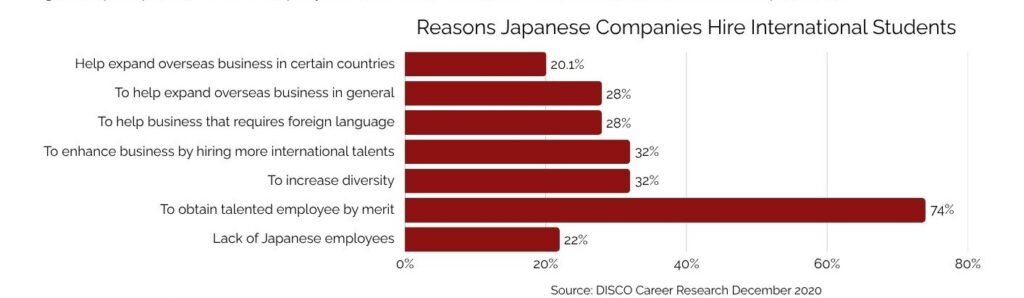
Businesses in Japan are turning to recruiting foreign workers to fill labor shortages. According to data collected by the Ministry of Health, Labor, and Welfare, as of October 2025, the number of foreign workers in Japan has increased to 2.6 million, a 11.7 percent rise from the previous year. The majority of foreign workers were employed in the manufacturing industry, accounting for 24.7 percent of all workers.
As a result of this ever-increasing number of foreign workers, Japan has introduced new visa types for prospective skilled workers; for example, it introduced the Specified Skilled Worker visa in 2019 to fill labor shortages in the country. In addition, organizations such as the Tokyo Employment Service Center for Foreigners have been established to help foreign residents (specifically, recent graduates) find jobs in Japan.
2. Increased digital transformation
A report published by the Organization for Economic Co-operation and Development (OECD) found that sectors such as Information and Communications, Wholesale and retail, and Finance and Insurance are more likely to use AI in their work, compared with sectors such as Accommodation, eating and drinking services.
3 Most In-Demand Jobs in Japan
Now that we’ve taken a look at what the factors are in Japan’s labor shortage, let’s take a look at jobs that are currently in demand.
For prospective and current job seekers, as well as fresh graduates, we’ve compiled a list of high-demand jobs in Japan. This may help you in your job search.
1. AI developers and tech
It is no surprise that, as it becomes increasingly competitive, Japan’s IT and tech sector remains in demand. With the rise of AI, demand for AI developers and specialists has also increased. The salary guide for the tech sector published by Morgan McKinley found that in 2026, AI, cloud infrastructure, and data skills are in high demand. They also found that while Japanese language fluency was once required for professionals in this sector, companies are now prioritizing AI knowledge over fluency.
The top roles that are in demand for this sector, according to the company, include Data Managers, AI Developers, and Cybersecurity Specialists.
2. Finance
Robert Walters’ salary guide found that jobs in finance are in increasing demand due to the weak yen, which attracts more foreign investors and, in turn, increases both the number of companies seeking to expand their finance teams and hiring activity.
They found that this sector still faces a shortage of junior to mid-career workers, which has led more companies to hire senior candidates. As for financial consultants, demand is high for mid- to senior-level professionals due to their experience in areas such as post-merger integration (PMI).
Look for jobs in private equity, M&A advisory, investor relations, and compliance roles if you want to break into the world of finance.
3. Recruitment
Morgan McKinley found that in 2026, the HR sector is seeing growing demand for bilingual professionals and specialists in this field. However, this sector remains a “candidate-short” environment due to skills shortages and low unemployment. In addition, HR governance and workforce planning expertise is in high demand as companies look to address wage inflation and working hours in the industry.
Highest Paying Jobs in Japan
Below is a list of the highest-paying jobs in Japan, including the average annual salary for each. For this section, we’re focusing on roles in the tech, finance, and professional services sectors, as they offer not only competitive salaries but also strong job security and the potential for long-term career growth.
(Disclaimer: Salary varies by experience, company, and language skills. This is just to show the average annual salary for jobs that earn a high amount of income.)
| Jobs | Average annual income |
| Technology Partner | ¥50,000,000 |
| Human Resources Director | ¥18,000,000 |
| Head of Medical Affairs | ¥26,300,00 |
| Fintech Sales Director | ¥45,000,000 (highest average) |
| Head of Finance | ¥17,500,000 |
Types of working visas you can get
To understand which jobs offer visa sponsorship, let’s look at the common types of working visas foreign job seekers can obtain in Japan.
Engineer/Specialist in Humanities/International Services visa
This is the most common visa type for white-collar workers in Japan. The Engineer/Specialist in Humanities/International Services visa (技術・人文知識・国際業務), or gijinkoku, covers a wide range of careers, including IT, translation services, and general office roles such as Human Resources and Marketing.
To obtain this visa, you will generally need to have a university degree related to your field of work or 10 years of relevant work experience to apply. The length of stay can vary based on how long you will be employed at your company and the desired length of stay.
Highly Skilled Professional visa
Another type of visa you can get is the Highly Skilled Professional visa, though this is more difficult to obtain. Foreign nationals who qualify as a Highly Skilled Professional include academic researchers and business managers.
The criteria for obtaining a Highly Skilled Professional visa are based on a points system that evaluates your educational background, work experience, and annual salary. The benefits of receiving this visa are that, compared to other work visas, you can apply for permanent residency in just three years with 70 points, or even one year with 80 points.
Read more about how to get Permanent Residency in Japan here.
Specified Skilled Worker visa (SSW)
This is a new type of visa introduced in April 2019 to address labor shortages in Japan. The visa covers 18 industries including food service, construction, and nursing care.
The SSW visa is divided into two types. The Type 1 allows you to stay up to a total of five years, whilst the Type 2 visa allows you to stay for an unlimited time, with no visa renewals required. In order to get this visa, you will need to meet certain requirements, such as passing both a Japanese language proficiency test and a technical test based on the industry you’re working in.
Generally, you will need to obtain the equivalent of a JLPT N4 proficiency in Japanese to obtain a Type 1 SSW visa, or JLPT N3 proficiency to get a Type 2 SSW visa.
Read more on Japan’s new Foreign Worker System in 2027 here.
Jobs in Japan That Offer Visa Sponsorship
Now that you understand what jobs are both high-paying and in demand, let’s take a look at jobs in Japan that offer visa sponsorship. For foreign job seekers, finding a job at a Japanese company that will provide visa sponsorship might seem impossible, especially as Japan is tightening its regulations and requirements for some visas. This is not the case, however, as it’s possible to find a company that will sponsor your visa.
1. IT/Tech
Japan’s tech sector is ever-expanding, and with the rise of AI, more workers are needed. Estimates from Japan’s Economy, Trade, and Industry Ministry predicted demand for 7.82 million workers in the AI and robotics fields by 2040, while also projecting a shortfall of 3.39 million workers in those fields that same year.
To get a job in tech, you might consider gaining some work experience in the tech sector in addition to a degree in Computer Science and knowledge of programming languages such as Python and Java.
2. Education
Jobs in the education sector, especially in English teaching, are a common choice for foreign job seekers, especially for those from Western countries. Some English teaching jobs, such as Assistant Language Teachers (ALTs), require just a Bachelor’s degree, having prior teaching experience or a teaching certificate can help you increase your chances of working in the education sector.
However, for some jobs, such as international school jobs, the requirements are much more strict, as they might require you to have a Master’s degree or a teaching license in your home country.
3. Nursing care
Due to Japan’s aging population, there is an increased demand for jobs in nursing care, however, the number of nursing care workers in fiscal 2023 decreased to 2.126 million workers, according to the Ministry of Health, Labor and Welfare. Because nursing care is one of the industries covered under the Specified Skilled Worker visa, there is an established pathway to becoming a nursing care worker in Japan; you just need to pass a Japanese language exam and obtain the equivalent of JLPT N4, as well as a specialized skills exam.
4. Hospitality
Japan’s tourism industry has seen an increase in demand for workers, as the country is facing rising tourist numbers in recent years. According to the Bank of Japan’s Short-Term Economic Survey of Enterprises in Japan, or Tankan, found that this sector, along with Construction, is more likely to report labor shortages.
Most workers in this industry can enter Japan’s tourism sector on a Specified Skilled Worker visa, as this visa category covers the accommodation and food service industry.
Skills That Increase Your Hiring Chances in Japan

While there are a variety of skills that Japanese companies are looking for when it comes to hiring, we recommend improving the following skills to increase your chances of landing a job in Japan:
1. Japanese language ability (JLPT)
Having Japanese language proficiency can increase your chances of getting hired in Japan. With Japan now requiring new visa applicants for the Engineer/Specialist in Humanities/International Services to have JLPT N2 proficiency in Japanese (with some exceptions), it might be helpful to start considering Japanese-language certification. It doesn’t even have to be strictly JLPT N2; there are other certificates out there that you can get, so long as you can meet the equivalent of JLPT N2. Not only will you need to demonstrate Japanese proficiency, but you will need to learn keigo (敬語) as well.
If you are looking to build your Japanese from the ground up or accelerate toward N2, Coto Japanese Institute offers full-time Japanese language programs in Tokyo designed for people who are serious about reaching proficiency and building a life in Japan.
Read more about what Japanese language certification gets you hired in Japan.
2. Technical certifications
Just having Japanese language skills may not be enough to get hired in Japan; you might want to consider upskilling to secure a job offer.
However, the technical skills you’ll want to aim for depend on the sector you want to work in; for example, in tech or IT, companies look for candidates with knowledge of programming languages such as Java, Python, C++, C #, or Ruby.
If you want to become an English teacher, you might consider getting a teaching certificate in your home country or obtaining a CELTA/DELTA (Certificate in English Language Teaching to Adults) or TEFL/TESOL (Teaching English as a Foreign Language) certificate.
3. Cross-cultural communication
Having cross-cultural communication skills can increase your chances of getting a job offer in Japan. This is why companies are looking for candidates who can speak multiple languages, because they can bridge the cultural barrier between international and Japanese clients. Not only will you need to demonstrate some form of multilingual proficiency, but you will also need to show that you understand cultural differences in the world of international business.
You will need to not just understand the language, but also Japanese business etiquette as well. Understanding nemawashi (根回し), which is to build a consensus before any formal meeting or decision is made, is essential to ensure that you are well integrated into the Japanese workplace. To do so, reading the room, or kuuki wo yomu (空気を読む), and building relationships amongst stakeholders is important.
4. STEM expertise
This is especially true for those who want to pursue a career in engineering or science in Japan. The Japanese government is projecting a loss of 3.3 million workers with STEM expertise by 2040, and as such, has introduced policies meant to raise the share of university students enrolled in STEM programs from less than 30 percent to 50 percent by 2040. That being said, having knowledge in STEM can be beneficial, especially in the sectors mentioned.
5. International work experience
While this might not apply to every job applicant, having international work experience can make you stand out as a foreign job applicant. This shows potential employers that you are internationally minded, in addition to having soft skills such as problem-solving and adaptability to different cultures.
If you are considering making Japan your next chapter, combining international experience with structured Japanese language study is one of the strongest ways to position yourself. Coto Japanese Institute supports students who are planning to live, work, and build a career in Japan, with programs that go beyond the classroom.
Conclusion: Knowing which jobs are in high demand can help you build your career in Japan.
Knowing the state of the job market in Japan can help you figure out what qualifications you need to work on in order to build your career in Japan. Finding a job that will sponsor your visa, even if the salary doesn’t meet your expectations, is still possible as well. Good luck, job seekers!
Want to start your career in Japan? Study with us!
After reading this article, you might be thinking of starting your career in Japan; however, you’re going to need proficiency in Japanese if you’re going to apply for jobs in Japan. If you want to improve your Japanese, why not come study with us at Coto Japanese Institute?
As a recently opened, MEXT-approved school with over 25 years of providing Japanese lessons, you’ll be able to learn Japanese in our modern campus with state-of-the-art facilities in Kokubunji. Our 1-year program is designed to help students prepare for a career in Japan, whether it’s through learning Japanese for both everyday life and business, or receiving job support from our staff.
Ready to start learning with us? We are currently open for our October and April intakes! Contact us below to get started on your application!
FAQ
Do I already need a valid work permit to apply to a job in Japan?
Not necessarily. While it’s true that some job listings require applicants to already have a valid work visa, others welcome applicants outside of Japan or will sponsor your visa upon receiving a job offer.
Do I need Japanese in order to work in Japan?
While it’s true that Japan is now requiring the equivalent of N2 proficiency in Japanese, this applies mainly to customer-facing jobs. Regardless, having Japanese proficiency can increase your chances of finding a job in Japan as the country is seeking out global, bilingual talent.
What are some sectors in Japan that are most affected by labor shortages?
According to the Bank of Japan’s tankan (短観), or the Short-Term Economic Survey of Enterprises in Japan in June 2025, the industries that are most likely to report labor shortages are construction and accommodations, and food services.
Read More:
- What the New Graduate Hiring Process is Like in Japan
- Best IT Job Hunting Sites in Japan for Developers and Tech