





“Do I really need to do an interview just to enroll in a Japanese language school?”
That is often the question we hear when people apply to a Japanese language school in Japan. As a Japanese language school that does conduct interviews as part of our application process, we understand the concern, surprise, and nervousness that come with it. Does the interview affect your admission? What is being evaluated? What is the admissions team looking for?
Long story short, interviews allow Japanese language schools to assess your readiness to study Japanese in Japan, understand your motivation for learning the language, and place you in the class that best matches your current level and learning needs.
For long-term schools accredited by the Ministry of Education, such as Coto Institute, the interview also serves to verify that applicants have demonstrated at least 150 hours of Japanese study and have the financial readiness to support themselves in Japan. But does this mean there is a pass-or-fail rubric? What can you expect, and how do you prepare?
While every school has its own process and evaluation criteria, we’d like to give you a clearer sense of what to expect during the interview and how to prepare!
What Is an Admission Interview, and Why Do Japanese Language Schools Have One?
A Japanese language school admission interview is a one-on-one session where the school assesses your Japanese level, understands your goals, and determines whether you are a good fit for the course you have applied for. It is typically around one hour, conducted online via video call.
Don’t think of the interview as a one-sided evaluation.
Yes, as a language school, we want to assess your current level of Japanese and ensure that the course you have selected is appropriate for your level. If necessary, we may recommend a more suitable class to help you succeed. At the same time, the interview is an opportunity for us to explain important information about student life, visa procedures, school policies, and what to expect when studying in Japan.
If you are invited to an admission interview, that is usually a positive sign. In most cases, your application has already been reviewed, and the admissions team believes you could be a good fit for the school!
Do All Schools Have a Placement and Admission Interview?
Not all Japanese language schools require an interview. If you are studying short-term without a student visa (for example, a three-month course) most schools skip the admission interview entirely.
Schools like Coto Academy encourage prospective students to join a free consultation and Japanese level check, but the criteria is relaxed. They even offer courses for complete beginners, such as their Japanese Crash Course.
Long-term language schools that sponsor student visas are different. The screening process tends to be more thorough, as schools are responsible for the students they sponsor.
How Difficult Will Your Interview Be?
Don’t think admission interview is a pass-or-fail test. There is no single difficulty level because the language assessment during the interview is calibrated to the Japanese level and the course you indicated in your application.
This is particularly true for the Coto Japanese Institute. For example, if you describe yourself as an intermediate learner and apply for our Advanced Japanese Communication & Career Growth, the questions and language assessment start at a more advanced level.
This is why it is important to be honest about your current level of Japanese when applying. Choosing a course level that is too high or too low will not reflect your true ability and may result in being placed in a class that does not suit your needs.
What Your Japanese Assessment Test in an Interview Might Actually Look Like
| Section | What to Expect |
|---|---|
| Self-Introduction | Your background, goals, and reasons for learning Japanese. About one minute. |
| Reading | A level-appropriate passage with a few minutes to read before questions. |
| Writing | A short written response to a prompt, sometimes linked to the reading passage. |
| Listening | A short audio clip played once, followed by comprehension questions. |
| Speaking & Roleplay | A scenario-based roleplay with a teacher as the other speaker. |
Every school conducts its Japanese-language assessment differently, but most Japanese language school admission interviews follow a similar format. At Coto Japanese Institute, while we cannot go into too much detail about the questions, here is what you can expect!
1. Self-Introduction
A self-introduction is standard in almost every admission interview. At Coto Japanese Institute, this is not just a chance to demonstrate your Japanese. It is also an opportunity to share your background and goals. To help you prepare, you can provide some guiding points:
- Where are you from?
- Your education or work background
- Why do you want to learn Japanese?
Of course, you can talk more than the pointers above! We typically allow around one minute for this, though it is not a strict rule.
Read more: How to do a jikoshokai (self-introduction) in Japanese
2. Reading Test
The reading section allows us to gauge your comprehension skills. You will be given a passage to read and a few minutes to analyze it before we move on to the questions, so there is no need to rush.
The complexity of the passage depends on the level you have selected. For beginner-level assessments, you will see little to no kanji, and any that appear will include furigana. For more advanced courses, expect denser text with a higher kanji count.
3. Writing Section
Depending on your level, you will be asked to write a short response to a prompt within a set word count. The topic varies, but it is sometimes connected to the reading passage. For example, if the passage is about the best restaurants in Tokyo, the writing prompt might ask: “What is your favorite restaurant in Tokyo?” We encourage you to draw from your own personal experiences and ideas.
One practical tip: make sure your Japanese keyboard is set up and ready before you join the session, and get comfortable typing in Japanese beforehand.
4. Listening Section
Similar to the JLPT listening section, you will hear a short audio clip (typically a conversation between two people) and answer questions based on what you heard. The audio is played once.
A common scenario involves people making plans, where details like time, location, or arrangements change throughout the conversation. You might be asked something like: “What time did they agree to meet?”
Listening questions can feel fast-paced, so staying focused from the start is key.
5. Speaking and Roleplay
Beyond the natural back-and-forth that happens throughout the interview, Coto Japanese Institute also includes a roleplay activity. You will be given a scenario and asked to respond, and one of our teachers will jump in as the other speaker, so it feels more like a real conversation than a test.
Other Things to Expect During the Interview

As mentioned, the language assessment is only one part of the interview. Here is what else typically takes place.
1. Common Questions About Your Background, Motivation, and Study Plans
This portion is often conducted in English, giving you a chance to express yourself more comfortably. Expect questions such as:
- Why do you want to study Japanese?
- How long have you studied Japanese? How did you study?
- What are your goals after completing the course?
- How long do you plan to study in Japan?
- Have you lived in Japan before?
There are no trick questions here. The admissions team is simply trying to get to know you and understand your motivation.
2. Q&A Session
Following the assessment, we hold a Q&A session. This goes both ways. Our admissions team will walk you through important topics such as student life, visa procedures, rules, and what to expect at Coto Japanese Institute, and you are also welcome to ask any questions you have.
Come with questions if you have them. This is a great opportunity to make sure the school and course are the right fit for you!
3. Confirmation About Your Financial Readiness
This one catches many applicants off guard, but Japanese language schools, including Coto Institute, are legally required to confirm that students have the financial means to support themselves while studying in Japan.
During the interview, we will ask about your financial situation and may follow up with questions such as:
- Who will be financially supporting you during your studies?
- What is their source of income or employment?
These questions can feel personal and uncomfortable, but rest assured that all information is treated with complete confidentiality and used solely for admissions and immigration purposes. It will not be shared beyond what is required.
If you have any questions about the financial requirement, you can inquire the team at Coto Institute.
Things You Need to Know About an Admission Interview
1. Keep the 150-Hour Japanese Study Requirement in Mind
For MEXT-accredited schools, applicants are typically required to demonstrate at least 150 hours of prior Japanese study. How this is assessed varies by school. Some accept self-study, while others require formal proof like a short-term course certificate or JLPT N5 qualification.
At Coto Japanese Institute, if you hold a university degree or higher, you do not need to submit proof of study hours. That said, you will still need to demonstrate basic Japanese proficiency through the interview assessment, equivalent to around JLPT N5 or A1 level, including the ability to read and write hiragana and katakana.
In other words, even without formal documentation, your Japanese ability still needs to meet a minimum standard. The good news is that this is a beginner-friendly bar and not at all designed to be intimidating.
We have written a full breakdown of the 150-hour requirement if you would like more details on how it applies to your situation.
Contact us below to start your application process with Coto Japanese Institute!
Want to study Japanese with us?
2. Interviews Can Be Conducted in Japanese and English
At Coto Japanese Institute, interviews are typically conducted by two staff members: a Japanese teacher who evaluates your Japanese language ability, and a bilingual admissions team member who helps facilitate the interview in English
This might look scary — having two people from the admissions team when you are interviewing alone — but we find that this approach helps ensure nothing gets lost in translation.
Applying for a long-term course and potentially obtaining a student visa is a major decision, and we want applicants to fully understand every step of the process.
Keep in mind that this varies from school to school. Some institutions conduct interviews entirely in Japanese, so it is worth checking in advance what to expect!
3. The Japanese Used Is Adjusted to Your Level
Does this mean you need to be fluent in Japanese before applying? Not at all.
The whole point of joining a language school is to improve. At Coto Japanese Institute, we believe in a learn-by-doing approach — one that prioritizes practical communication over textbook drilling. That philosophy starts from the very first step of your journey with us: the admission interview.
During the interview, our teachers naturally adjust their speaking level to match yours. Coto Japanese Institute teachers — like professional Japanese instructors in general — are experienced in communicating with non-native speakers.
For example, instead of asking “生年月日はいつですか?” (Seinen gappi wa itsu desu ka?), a teacher might ask “バースデーはいつですか?” (Baasudee wa itsu desu ka?) — since baasudee is a loanword from “birthday” that most beginners recognize immediately.
If you get stuck or forget a word, don’t panic. Do your best to explain yourself, use English when you need to, and our bilingual admissions staff will help bridge the gap. The goal is never to trick you or put you on the spot!
4. There Is Usually a Rubric for Your Japanese Assessment
Many applicants imagine that teachers simply decide whether someone “sounds good” in Japanese. In reality, most schools use structured evaluation criteria to keep assessments consistent and fair.
Without giving too much away about our own evaluation system, interviews generally assess areas such as:
- Speaking ability
- Listening comprehension
- Reading comprehension
- Grammar and sentence structure
- Ability to communicate ideas and opinions
Each area is typically scored or rated, so the process is more objective than it might seem.
Remember, the goal is not to determine whether you are “good enough.” It is to identify the class level where you will learn most effectively. Think of it as a placement assessment, not a pass-or-fail test.
Can Schools Choose Not to Invite You to an Interview?
In some cases, you may not be invited to an interview if your application is too vague, your current Japanese level is below the minimum requirement, or you are looking for a short-term course that the school does not offer.
When applying directly to a language school, admissions teams initially screen your profile based on the information you submit. A common reason for not being invited is that answers to key questions are too general.
For example, Coto Japanese Institute asks applicants to share their motivation for learning Japanese. You don’t need to write a full essay, but providing specific details — rather than simply writing “I want to be fluent” — helps us understand that you are genuinely motivated.
At Coto Japanese Institute, you will always receive a response, regardless of the result.
We also redirect applicants when needed. For instance, if you are looking for a six-month course, which falls outside Coto Institute’s focus, we will point you toward Coto Academy, our sister school that specializes in short-term programs. Similarly, if you have no prior Japanese study experience, we will advise you to take a beginner course first before reapplying.
Contact Coto Academy for short-term Japanese lessons.
Can You Get Rejected After the Interview?
In most cases, the admission interview for Japanese language schools is not designed to reject students.
That said, concerns may arise in situations such as:
- Having virtually no Japanese study experience despite applying for a course that requires prior knowledge
- Showing little interest or motivation to study Japanese
- Providing inconsistent information about your study plans
- Having unrealistic expectations about studying or living in Japan
If your Japanese level is lower than expected, we will typically recommend a more suitable course rather than turn down your application outright.
If your level is not yet strong enough for the current intake, we might also ask you to retake the assessment test for the following term.
It is worth noting that the interview is separate from the next stage of the process: applying for a Certificate of Eligibility (COE), which is required to obtain a student visa. Unlike the admission interview, the COE is reviewed and approved by Japan’s Immigration Services Agency — meaning the final decision rests with immigration authorities, and there is always a possibility that an application may be denied.
The good news is that language schools typically only proceed with COE applications for students they believe have a strong chance of approval!
Tips to Have a Smooth Japanese Language School Interview
1. Prepare Your Self-introduction
You do not need to memorize a perfect script for your self-introduction. Being able to introduce yourself naturally is often more valuable than reciting a rehearsed speech.
One thing worth keeping in mind: given recent immigration scrutiny around fraudulent student visa cases, schools want to see that your primary motivation for coming to Japan is genuine study. Make sure your reason for learning Japanese is clear, specific, and honest.
2. Don’t Rely (Entirely) on AI
It can be tempting to use tools like ChatGPT or Gemini to write a polished self-introduction in advanced Japanese. However, this can work against you during the interview.
If your introduction sounds like it was written by a JLPT N2 student but your actual ability is beginner level, interviewers may place you in a class that does not match your real level, which ultimately makes your experience harder, not better.
A quick note on the writing section: write your response yourself! It might be tempting to use AI, but the whole point is to show where you actually are with your Japanese. That’s how the school can place you in the right class and give you the support you need.
3. Show Your Motivation
Schools want to understand why you are learning Japanese. You do not need an extraordinary reason or a detailed five-year career plan — though if you have one, that is absolutely welcome. Simple, honest motivations are often the most compelling.
Common examples include:
- Working in Japan in the future
- Entering a Japanese university or vocational school
- Living more comfortably in Japan
- A love of Japanese culture, anime, or literature
What matters most is that your goals feel genuine and that you are clearly committed to studying.
If your answer is too broad, the admissions team may ask follow-up questions to get a clearer picture. For example, if you say you want to study Japanese to communicate with a Japanese friend, they might ask: “Why is that important to you?” Having thought through your reasons in advance will help you answer confidently.
4. Set Up Japanese Text Input Before the Interview
The written assessment may require you to type in Japanese. While we cannot assess handwriting in an online setting, we can evaluate your ability to compose in Japanese, so it is worth being comfortable with your input method beforehand.
Most computers support Japanese input using a romaji-based system, which lets you type using the standard alphabet and converts it to hiragana, katakana, or kanji. Make sure it is downloaded, set up, and familiar to you before interview day.
Read More: How to Type in Japanese on Apple Devices
Ready to Take the Next Step and Study Japanese in Japan? Join Coto Institute!
A Japanese language school admission interview is less intimidating than it sounds. With a little preparation, an honest sense of your current level, and a clear idea of why you want to study Japanese, you are already most of the way there!
At Coto Japanese Institute, we designed our admissions process to be as transparent and supportive as possible, because we want you to feel confident before you even walk through the door.
If you have questions about the process or are ready to apply, we would love to hear from you. Take the first step and apply to Coto Japanese Institute today!
FAQ
How long is a Japanese language school admission interview?
Typically around one hour in total, including the language assessment and Q&A session.
How is the interview conducted?
Most interviews are held online via video call, since the majority of applicants are still living outside Japan at the time of application.
What happens after the admission interview?
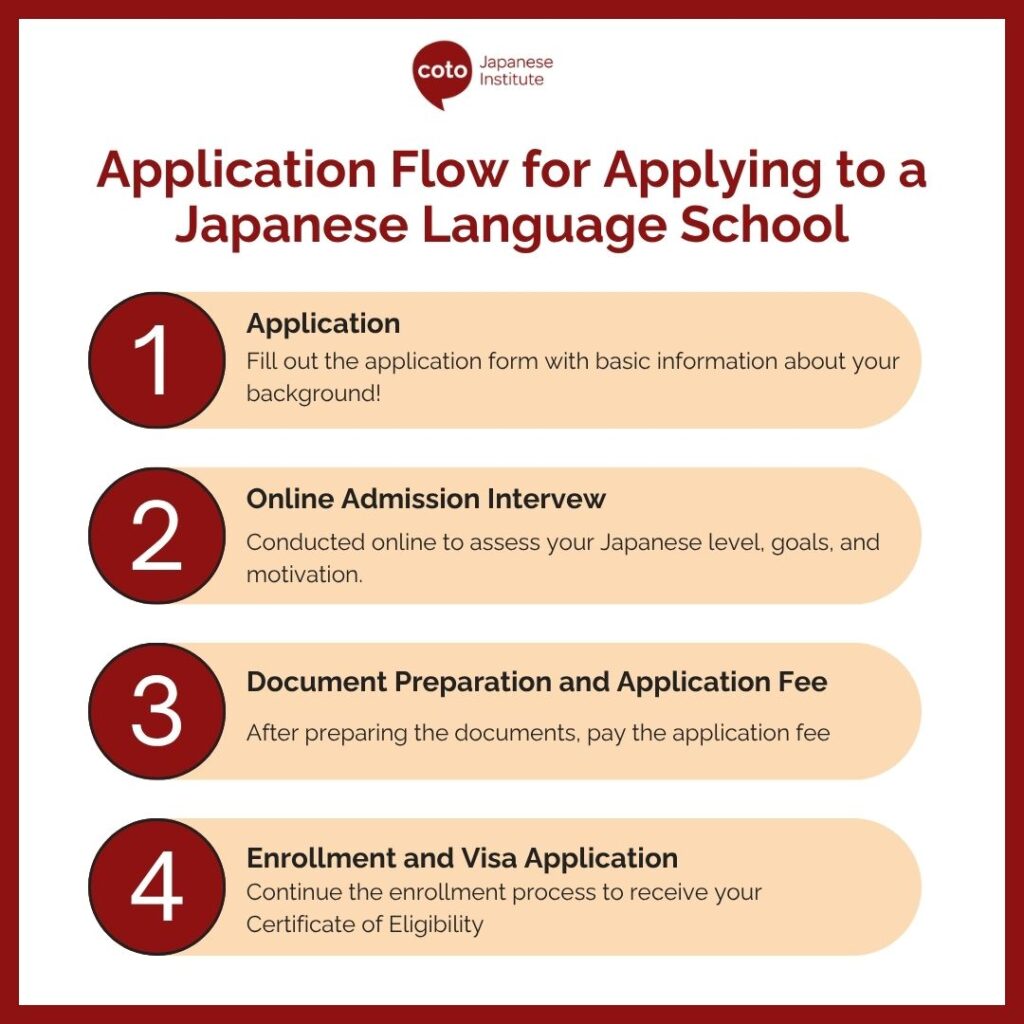
If your application moves forward, the next step is document preparation for your student visa application, including applying for a Certificate of Eligibility (COE).
Can you get rejected from a language school?
If your motivation is unclear or your Japanese ability does not meet the minimum requirement, we will typically encourage you to reapply for the following intake after some additional preparation.
Do I need proof of 150 hours of Japanese study?
It depends on your situation. At Coto Institute, if you hold a university degree or higher and can demonstrate approximately JLPT N5 level ability through the interview assessment, formal proof of study hours is not required.