





You might have heard about general do’s and don’ts in Japan, such as “don’t eat while walking” or “take off your shoes indoors,” but did you know that there are do’s and don’ts you should remember as a student in Japan?
As a Japanese language school, Coto Institute has received these questions, both from applicants and from our new students. In this article, we’ll talk about certain rules and guidelines that we recommend that you follow, whether it’s for legal reasons or to make your life in Japan smoother. Follow these do’s and don’ts, and you’ll be living your best student life in Japan in no time!
Don’t: Work More Than 28 Hours/Week
If you’re planning to work part-time while studying, and you managed to get your Permission to Engage in Activities Outside Your Status (aka the stamp at the back of your Residence Card), then there are rules that you’ll need to follow.
While this permit allows you to work part-time, you’re not allowed to work more than 28 hours per week, or more than 40-hours per week during school holidays. In addition, there are certain industries you’re not allowed to work in, such as the adult industry (which includes host clubs, love hotels, and pachinko parlors). Always check with your school on what part-time jobs are permitted, and always check if your contract meets the legal limit of 28-hours per week.
Read more on our guide to part-time jobs in Japan here.
Want to study Japanese with us?
Do: Get Exempt from Paying National Pension System
While it’s true that everyone aged between 20 and 59 needs to pay into the National Pension, did you know that students are exempt from paying under a certain system?
The Special Payment System for Students allows you to postpone your pension payments while focusing on your studies. Students of any Japanese educational institution who are either unemployed or have an income that’s equal to or less than a specified amount are eligible to apply.
To apply for this system, go to your local municipal office or Japan Pension Service office. You will need to complete an application to postpone your pension payments each year under this system.
Don’t: Skip Japanese Lessons
This may sound like a no-brainer, but skipping your classes can have serious short and long-term repercussions. Having a low attendance rate can cause issues in future visa applications, whether you’re applying to other Japanese higher institutions or seeking employment in Japan. Not only that, but immigration can look into your attendance and potentially revoke your visa (if the school decides to expel you for low attendance).
For example, at Coto Japanese Institute, we typically expect students to have a high attendance rate, both to comply with immigration law and because we find that skipping classes is not the best way to truly progress.
To avoid this, make sure to attend every class on time (Japanese people value punctuality). For language schools, especially, they require you to maintain an attendance rate of more than 70 percent, but at some schools, it could be higher. If you need to take a leave of absence due to illness or unavoidable emergencies back home, let the school know in advance.
Do: Apply for a My Number Card
Having a My Number Card, officially called the Individual Number Card, can benefit you in a variety of ways aside from confirming your identity. For example, you can use your My Number Card in lieu of your Health Insurance card whenever you receive medical care. In addition, if you’re planning to move out of your ward, you can instead apply to change your address on the My Number Portal! There are many applications for your My Number Card in Japan.
To get a My Number Card, apply through your local municipal office.
Don’t: Eat or Sleep During Class
Not eating and sleeping during class is more of a universal rule. Drinking is usually alright (so long as it’s not alcohol), but save your lunch or a quick nap during breaks.
Do: Apply for a Parking Sticker for Your Bicycle
If you have a bicycle, you might have heard about registering it with the police, but did you know that you will need a parking sticker if you’re planning to commute to school on your bike? To apply for a parking sticker, you’ll need to apply through the school and fill out the designated forms to be submitted. Once you’ve received your sticker, place it somewhere visible on your bike.
Coto School Finder, our team, which is dedicated to helping you find other language schools across Japan, has made a really useful guide on how to register your bicycle in Japan.
Don’t: Fall for a Yami Baito (闇バイト)
You might have heard about job scams online, and this is one of them. A yami baito, literally translated to “dark part-time job,” is literally what it is: a shady part-time job. The job listing might ask you to do low-effort tasks in exchange for high earnings, such as withdrawing money from an ATM.
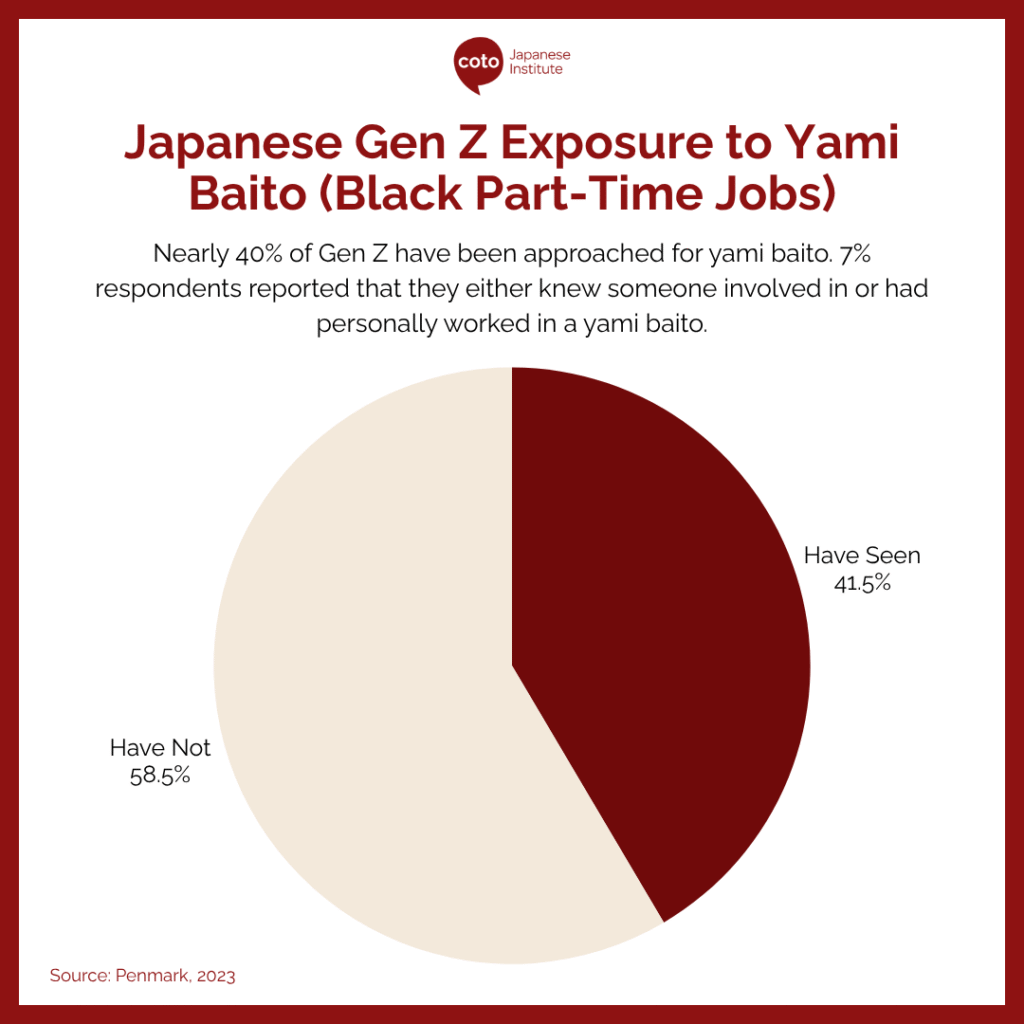
In fact, a survey conducted by a recruitment company, Penmark, noted that 41% Gen Zs in Japan have been approached for illegal part-time jobs. About 7% of students have experience with illegal part-time jobs or know someone who has. This is quite a big pool, and could grow bigger if you don’t exercise precautions.
Getting yourself into a yami baito has serious legal repercussions. Since these ‘jobs’ can be connected to fraud, theft, or even money laundering, you can be arrested for committing a crime, which can lead to imprisonment or even deportation.
To spot a yami baito, look out for the following signs:
- Promises of high returns for minimum work or unskilled labor
- Tempting wording, such as “high-paying” or “easy money”
- The scammer contacts you on social media or some unreliable online platform (aka not a job listing website)
- The listing asks you to do the following:
- Withdraw money using someone else’s bank books/cash cards
- Sign up for a mobile phone contract
- Create a fake residence card
If you’re unsure about a job listing, seek advice from your school or the police (if you really think that it’s a yami baito).
Do: Get your Health Insurance Premiums Reduced
In Japan, every resident needs to be enrolled in National Health Insurance and pay into the system. Premiums are calculated based on income, so if you’re a student with no income, make sure to apply to get your health insurance premiums reduced. This ensures that you’re not financially burdened whilst you live in Japan, as you can pay the premiums monthly or all in one go.
Read more: Guide to apply for health insurance and pension in Japan as a student
Don’t: Talk on the Phone While on the Train
You may not know this, but talking on the phone while on the train is considered to be bad manners. This is because you’re expected to be quiet on the train, so the last thing you want to get yourself into is your phone ringing in a tight, crowded train full of commuters trying to tolerate the journey.
It’s always best to set your phone to silent mode in this scenario. If, in the unfortunate event that someone does call you on the train, do not hang up the call. Instead, answer the phone and politely explain that you’re on the train now, and that you’ll call them back later. If the call was about something important, then get off at the nearest station and call them back immediately.
Do: Make The Most Out of Your Experience in Japan!
Just because you’re a student in Japan doesn’t mean that you have to be so focused on your studies. Instead, take the opportunity to make new connections, join a local meetup or club, or network if you’re job hunting! Making the most out of your experience in Japan can really make a difference, whether you’re seeking employment in Japan or planning to move out of the country when you’re done with your studies. The last thing you want to do is to get on that plane and express a single ounce of regret.
It might be worth joining school events as well. Coto Japanese Institute, for example, offers a variety of cultural events such as festivals and workshops that allow students to learn about the culture, but also to make lifelong friends along the way.
Final Thoughts
Knowing these guidelines can ensure that you live your best life in Japan as an international student. While it’s true that you need to follow a lot of rules in Japan, know that they’re not meant to disrupt your life, but to make your life easier during the course of your stay. So make sure to follow the rules and etiquette of Japan, and you don’t have to worry about anything!
Want to experience student life in Japan? Study with us!
Knowing the do’s and don’ts of living in Japan as a student is easy to follow, but finding a school to study in can be difficult. If that’s the case, why not come study with us at Coto Japanese Institute? As a recent MEXT-approved school with over 25 years of experience teaching practical Japanese, we can help you learn more about the culture so that you can live out your life in Japan.
Ready to study in Japan with us? We’re now accepting applications for April 2027. Contact us below to get started on your application!
FAQ
Can I eat or drink while walking?
In general, while it’s not illegal to eat or drink while walking, it’s considered to be bad manners.
Can I talk on the train?
It’s best to keep conversations to a minimum while you’re on the train. If you do need to talk, talk quietly.
How should I greet my teachers in Japan?
Looking to study Japanese in Japan? Read related articles:
Looking to study Japanese in Japan? Read related articles:
- What is the COE & Why Do You Need it for Japan’s Student Visa?
- What Actually Happens During Your Japanese Language School Interview
- 5 Reasons Why Your Japanese Student Visa Can Be Rejected