






You got a job at a Japanese company, and while it may be exciting to start, you might also be wondering which phrases you need to know for your first day. As the countdown to your start date gets closer, you might be feeling nervous about what to say when you meet everyone.
Not to worry, getting past the interviews is the hardest part. On your first day, you will mostly be introducing yourself to your fellow colleagues and getting to know them. So, let’s go through some essential phrases you should know for making the best impression possible on your first day at a Japanese company!
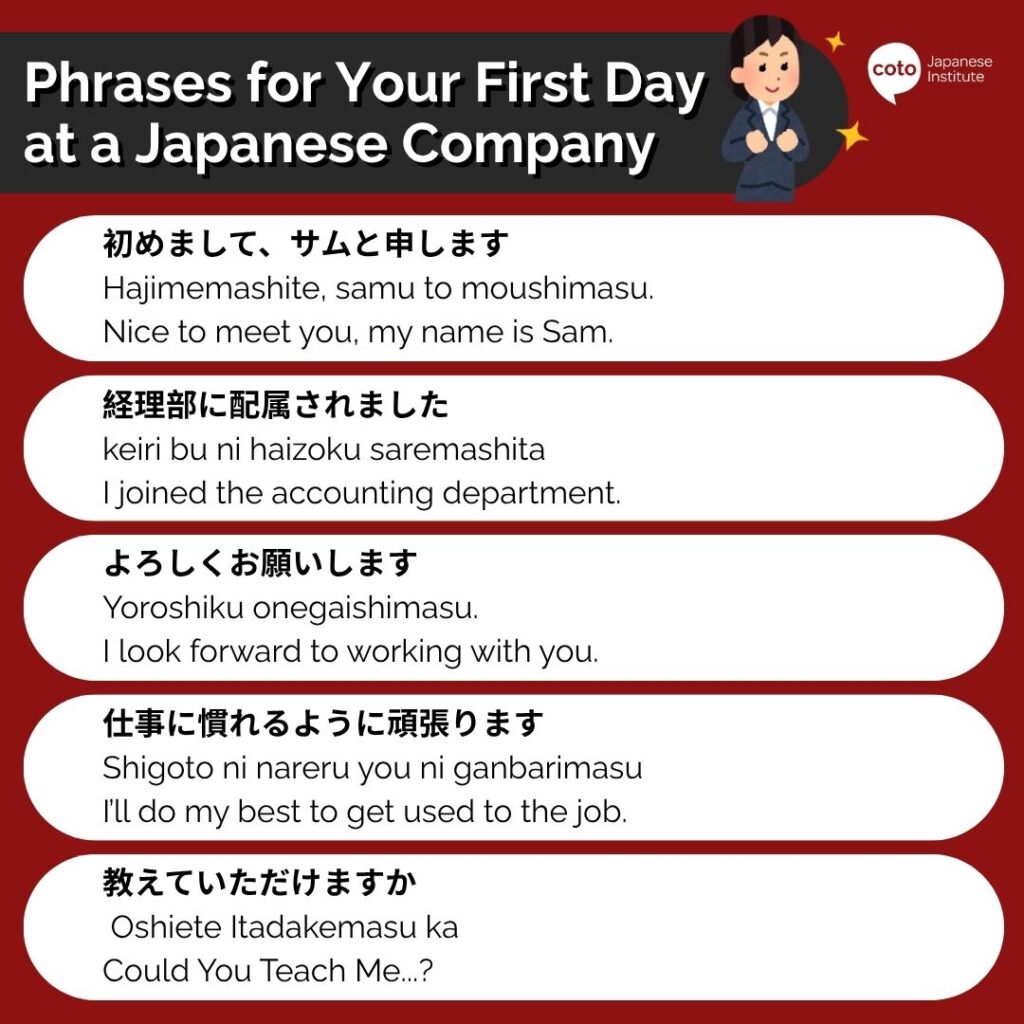
自己紹介 (Jikoushokai): Self-Introduction on Your First Day at a Japanese Company
When you first meet your colleagues, you’ll need to introduce yourself, which is etiquette not unique to Japan. Depending on your company or team, you may give a short jikoshokai to everyone. You might also just introduce yourself as you go around meeting your colleagues. Whichever the case may be, here are some phrases you should use.
Wondering how fresh graduates get hired? Read our blog: What New Graduate Hiring Process in Japan Looks Like
1. 初めまして (Hajimemashite): Nice to Meet You
This phrase is the first thing you say in a self-introduction or just when meeting someone for the first time. 初めまして (Hajimemashite) literally translates to “it is the first time,” but is closer to meaning “nice to meet you.” You only use this phrase when meeting someone for the very first time.
Example:
初めまして。
Hajimemashite
Nice to meet you.
2. 〜と申します (~to moushimasu): My Name is…
When you meet someone for the first time, you usually need to provide your name. There are many ways to do this. The simplest is just to say your name + です (desu). You can usually provide your name right after saying 初めまして (hajimemashite).
Example:
初めまして、サムです。
Hajimemashite, samu desu.
I’m Sam, nice to meet you.
When you give a more proper jikoshokai, especially in formal settings, you usually say your name + と申します (to moushi masu), which is the humble keigo version of 言います (iimasu). They both mean “to say” or, in this context, “I’m called (your name).”
Example:
初めまして、サムと申します。
Hajimemashite, samu to moushimasu.
Nice to meet you, my name is Sam.
3. 〜と呼んでください (To yonde kudasai): Please call me…
If you have a nickname you prefer, or feel that people may be confused about which name to refer to you, you can use the phrase 〜と呼んでください (~to yonde kudasai), meaning “please call me…” It’s a useful and polite way to let people know how they should best refer to you.
Example:
サムエルと申します。サムと呼んでください。
Samueru to moushimasu. Samu to yonde kudasai.
My name is Samuel, but please call me Sam.
4. 〜から参りました (~Kara mairi mashita): I come from…
Usually, you also tell people where you come from when you first meet them. In a formal jikoshokai, you can say 〜から参りました (~kara mairimashita), which means “I come from…” 参りました is actually the humble keigo form of 来ました (kimashita), so it works very well when giving a polite self-introduction.
Example:
カナダから参りました。
Kanada kara mairimashita.
I come from Canada.
5. 〜部に配属されました (~bu ni haizoku saremashita): Joined the… Department
Generally, when you introduce yourself in your new workplace, it’s nice to let your colleagues know which team or department you are joining. The phrase 配属されました (haizoku saremashita) means “been placed in…” It is a very polite way to describe the team or department your company is letting you join.
されました (saremashita) is the polite past passive form of する (suru), meaning “to do.” The passive form is ideal for focusing on how you’ve been placed in a certain department.
Example:
経理部に配属されました。
Keiribu ni haizoku saremashita.
I’ve been placed in the accounting department.
6. 趣味は〜することです (Shumi wa… suru koto desu): My hobby is…
Near the end of your self-introduction, it’s common to briefly discuss something about yourself, like your hobbies. It’s quite typical for Japanese people to share things they like to do as an ice-breaker and just to share a bit more about themselves. It’s always a nice gesture to discuss your hobbies when introducing yourself, just to show your willingness to get to know everyone in the office.
Example:
趣味はギターを弾くことです。
Shumi wa gitaa o hikukoto desu.
My hobby is playing the guitar.
7. よろしくお願いします (Yoroshiku onegaishimasu)
After you have finished introducing yourself, it is customary to say よろしくお願いします (yoroshiku onegaishimasu)、 which doesn’t really have a great English translation. It’s a very polite expression that conveys your desire to continue working with your colleagues, especially in the context of introducing yourself at your company. It means something like “please be good to me” or “I’m sorry to keep bothering you,” but it conveys a very polite and friendly desire to keep getting to know the listener(s).
However, yoroshiku onegaishimasu is used far beyond self-introductions. It’s used at the end of business emails, when making requests, or even when saying “Happy New Year.” It’ll probably be one of the common expressions you will use and hear in the office and even outside of it.
Example:
どうぞよろしくお願いいたします。
Douzo yoroshiku onegaiitashimasu.
I look forward to working with you further/I appreciate your support going forward.
Putting the 自己紹介 (Jikoshoukai) Altogether
So, if you need to put together a short 自己紹介 (jikoshoukai) for your first day at a Japanese company, here is an example putting all the expressions above together to give a great impression.
Example:
初めまして。
サムエルと申します。サムと呼んでください。
カナダから参りました。日本で働きたいから、日本に来ました。
今日から経理部に配属されました。
趣味はギターを弾くことです。
どうぞよろしくお願いいたします。
Hajimemashite
Samueru to moushimasu. Samu to yonde kudasai.
Kanada kara mairimashita. Nihon de hatarakitai kara nihon ni kimashita.
Kyou kara, keiribu ni haizoku saremashita.
Shumi wa gitaa o hikukoto desu.
Douzo yoroshiku onegai itashimasu.
Nice to meet you.
My name is Samuel, but you can call me Sam.
I come from Canada, and I came to Japan to work.
Today, I will be joining the accounting department.
My hobby is to play the guitar.
I look forward to working with everybody.
General Phrases to Know on Your First Day
To start, let’s go through some general phrases you should know for your first day in the office, many of which you will use far beyond your start date.
8. おはようございます (Ohayou Gozaimasu): Greeting When You Enter
You’ve probably heard this phrase before, but it’s the usual greeting when you clock in and see your colleagues. おはよう (ohayou) translates to “good morning,” as you likely learned before, and adding ございます (gozaimasu) adds a layer of politeness that works perfectly in the office.
So, when you first enter your office, you can say おはようございます to your colleagues as a warm greeting. Even if you don’t start your shift in the morning, it is common to say this phrase whenever you clock in.
Example:
おはようございます
Ohayou gozaimasu.
Good morning
9. お疲れ様です (Otsukaresama desu): Thank you for your hard work
お疲れ様です is probably one of the most frequently used phrases in the Japanese workplace. Whenever you see your colleagues passing by, greeting them with お疲れ様 (otsukaresama) adds warmth and appreciation. It conveys your friendliness and desire to be close to your colleagues.
Example:
お疲れ様です。今日からお世話になります。
Otsukaresama desu. Kyou kara osewa ni narimasu.
Thank you for your hard work. I’ll be in your care starting today.
10. 頑張ります (Ganbarimasu): Give it my best!
頑張ります (ganbarimasu) is one of the most commonly used phrases in Japanese workplaces. It comes from 頑張る (ganbaru), which means “to do one’s best” or “to persevere.” It’s a great way to show you’re motivated and ready to put in the effort, and you’ll often say it at the end of a self-introduction or when someone gives you a task.
Example:
一生懸命頑張りますので、よろしくお願いいたします。
Isshoukenmei ganbarimasu node, yoroshiku onegai itashimasu.
I’ll work hard, so I look forward to working with you.
11. 仕事に慣れる (Shigoto ni nareru): I’m getting used (to the job)
On your first day, it’s common to tell your colleagues you’re hoping to settle in quickly. 慣れる (nareru) means “to get used to,” so 仕事に慣れる (shigoto ni nareru) means “to get used to the work.” Your coworkers will understand that you’re new and still learning, so it’s a nice way to set expectations while showing you’re keen to adapt.
Example:
早く仕事に慣れるように頑張ります。
Hayaku shigoto ni nareru you ni ganbarimasu.
I’ll do my best to get used to the work quickly.
12. 教えていただけますか (Oshiete Itadakemasu ka): Can you teach me..?
You’ll have a lot to learn in your first few days, so this is a very handy phrase. 教える (oshieru) means “to teach” or “to tell,” and 〜ていただけますか (~te itadakemasu ka) is a humble way of asking someone to do something for you. It sounds polite and shows your colleagues you’re willing to learn, which is exactly the impression you want to give as a newcomer.
Example:
すみません、この書類の書き方を教えていただけますか?
Sumimasen, kono shorui no kakikata o oshiete itadakemasu ka?
Excuse me, could you teach me how to fill out this document?
13. お先に失礼します (Osaki ni Shitsurei Shimasu): I’m leaving first
Many Japanese offices have a culture where people stay late, so you’ll often leave while others are still working. When you head home, use お先に失礼します (osaki ni shitsurei shimasu), which literally means “excuse me for leaving ahead of you.” Your colleagues will usually reply with お疲れ様でした (otsukaresama deshita), meaning “thank you for your hard work.”
Example:
お先に失礼します。お疲れ様でした。
Osaki ni shitsurei shimasu. Otsukaresama deshita.
Excuse me for leaving first. Thank you for your hard work.
Conclusion: Remember a Few of These Phrases for Your First Day at a Japanese Company!
You may be nervous about starting your first day at a Japanese company, but since you made it this far, it only gets easier from here. Just try to remember a few of these phrases to make a great first impression. Everyone will be excited to get to know you, so all you have to do is be yourself!
Need to know what skills Japanese companies are looking for? Check out our guide: Top 10 Skills Japanese Companies Seek from Foreigners
Fully Prepare for Your First Day at a Japanese Company with Coto Institute
In order to fully prepare for your first day at a Japanese company, you should become confident in speaking business Japanese, which is what Coto Institute is here to do! We strive to help anyone who is dreaming of working in Japan with our practical conversation-focused courses, mock interviews, and resume support.
So, if you’re ready to sign up or would like to have a casual chat for more details, simply fill out the form below, and we will get in touch with you soon!
FAQ:
How do I introduce myself on my first day at a Japanese company?
Start with 初めまして (hajimemashite), then say your name with 〜と申します (~to moushimasu). You can add where you’re from, your department, and a hobby, and finish with どうぞよろしくお願いいたします (douzo yoroshiku onegai itashimasu).
What does よろしくお願いします mean, and when do I use it?
It has no exact English translation, but it means something like “please be good to me” or “I look forward to working with you.” It’s used at the end of a self-introduction, in emails, and when making requests.
What should I say when I arrive at the office in the morning?
Say おはようございます (ohayou gozaimasu) to your colleagues. It’s common to use it whenever you start your shift, even if it’s not actually morning.
What should I say when leaving the office before my coworkers?
Use お先に失礼します (osaki ni shitsurei shimasu), meaning “excuse me for leaving ahead of you.” Your colleagues will usually reply with お疲れ様でした.