





If you’re dreaming of working in Japan, having just a few handy Japanese phrases can go a long way to make lasting impressions in your job interview! Just like in English, mastering job interviews is just about being yourself and effectively communicating the best parts of you for the job you’re applying for.
So, let’s go over some key expressions that will help you do just that! These phrases will highlight who you are, respectfully and politely.
Language in Japanese Job Interviews & How to Impress Interviewers
Before we dig into our top Japanese job interview phrases, it’s best to quickly discuss the type of language used in job interviews. As you might expect, they are very formal occasions, so you must use formal Japanese, known as 敬語 (keigo). Keigo has several layers: you should use humble form when you’re speaking about yourself and honorific form when you’re speaking about someone else. Some of the expressions we will go over will incorporate either of these keigo forms.
But for the most part, you can just use です (desu) and ます (masu) form throughout the interview to show more respect. It’s more important that you come across as polite and respectful. So, don’t stress too much about which keigo form to use; just avoid casual or overly direct language that could come across as brash or rude.
It’s most important that for each question, you give thorough answers, especially when you give a self-introduction, or 自己紹介 (jikoshoukai). A good jikoshoukai includes your name, the country you came from, a bit about your work or school experience, and why you are applying. For a complete breakdown, check out our Coto Academy blog: Guide to Self-Introduction in Japanese Job Interviews
Now, here are our top phrases you should try to keep in mind for your Japanese job interview.
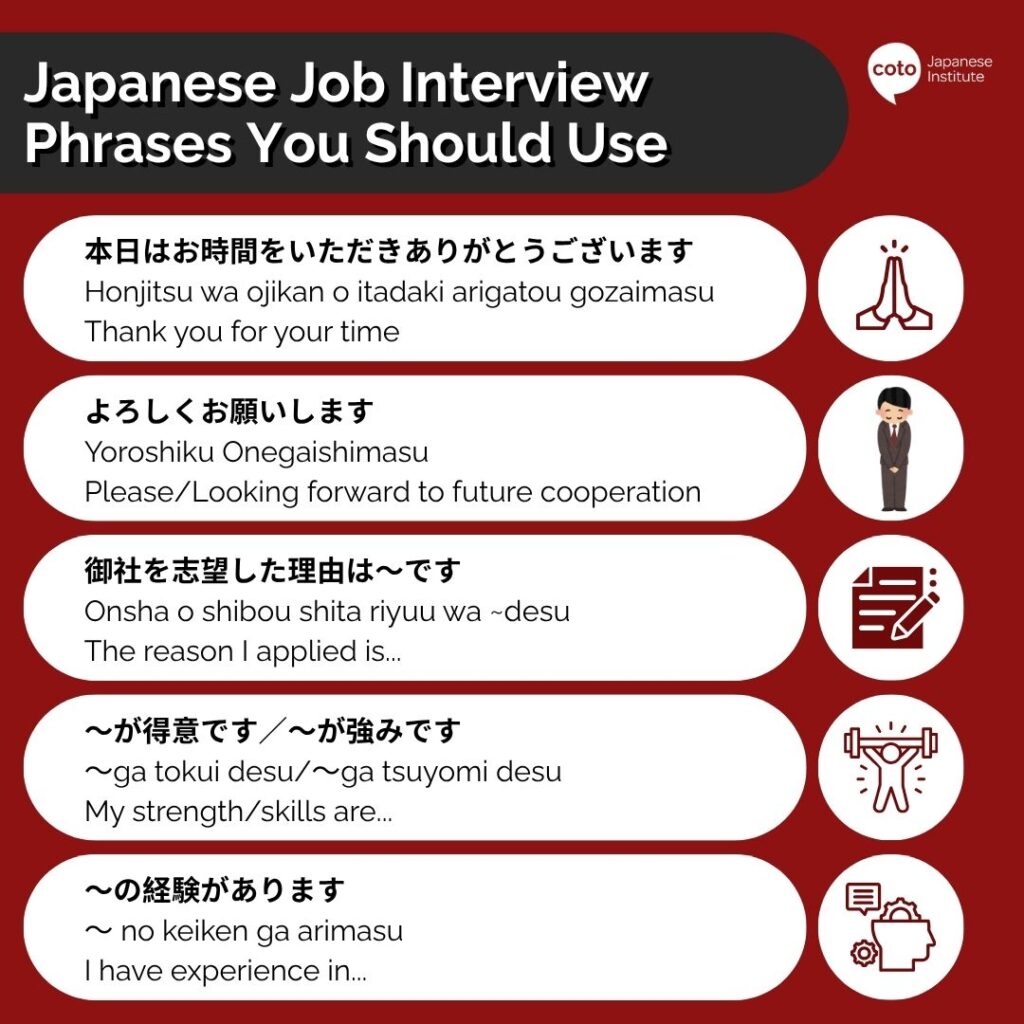
1. 本日はお時間をいただきありがとうございます。(Honjitsu wa ojikan o itadaki arigatou gozaimasu): Thank You for Your Time
This is one of the most important phrases to have ready for your Japanese job interview and one of the first things you will say to the interviewer. It is a natural phrase that shows appreciation for the interviewer’s time at the start of the meeting.
本日 (honjitsu) is the formal keigo equivalent of 今日 (kyou), meaning “today,” and using it immediately sets a respectful, professional tone right from the opening moment of the interview. The word いただき (itadaki) is the humble keigo for もらう (morau) or “to receive.” So, it’s a very respectful way to acknowledge the time you are humbly receiving.
Example:
本日はお時間をいただきありがとうございます。どうぞよろしくお願いいたします。
Honjitsu wa ojikan o itadaki arigatou gozaimasu. Douzo yoroshiku onegai itashimasu.
Thank you very much for taking the time to see me today. I look forward to speaking with you.
2. よろしくお願いします (Yoroshiku Onegaishimasu)
This one might seem obvious, but you will need to use it more often than you think! You don’t just use it at the end of your self-introduction; you can use it at the end of the interview, asking for a kind favor, or when expressing an interest in positive future interactions with them.
It’s an extremely useful and versatile phrase that doesn’t have a direct English translation. It can translate to “please treat me well,” “I look forward to future cooperation,” or a very polite “please” depending on context. So, in your Japanese job interview, expect to use this phrase far beyond initial greetings.
Example:
インタビュアー:来週、面接の結果につきましては、改めてご連絡いたします。
Intabyuyaa: Raishuu, mensetsu no kekka ni tsukimashite wa, aratamete go renraku itashimasu.
Interviewer: We will contact you about the interview results next week.
あなた:ありがとうございます。よろしくお願いします。
Anata: arigatou gozaimasu. Yoroshiku onegaishimasu.
You: Thank you very much. I look forward to hearing from you.
3. 失礼します (Shitsurei shimasu): Excuse me
失礼します literally means “I am being rude” or “I am about to be impolite,” which sounds almost like an apology you would only give for being disrespectful. But it is actually a very important and widely used expression of politeness in professional settings.
You will use it when entering or leaving the interview room, sitting down, or ending the interview. Think of it as the Japanese equivalent of “excuse me” in a formal context; it signals that you are mindful of social boundaries and respectful of the other person’s space.
Example:
(Knocking 3 times and entering the interview room)
あなた:失礼します。〇〇と申します。本日はよろしくお願いいたします。
Anata: Shitsurei shimasu. 〇〇 to moushimasu. Honjitsu wa yoroshiku onegai itashimasu.
You: Excuse me. My name is 〇〇. Thank you for having me today.
4. 〜を志望しております (〜 o shibou shite orimasu): Expressing the Position You Are Seeking
When asked why you are applying or what position you are interested in, 志望しております (shibou shite orimasu) is the natural and appropriately humble way to express that you are applying for or seeking a particular role.
志望 (shibou) means “aspiration” or “desired goal,” and using しております (shite orimasu), the humble form of しています (shiteimasu), communicates the right level of formality, since you are humbly seeking a position at their company.
Example:
インタビュアー:どのようなお仕事をご希望ですか?
Intabyuyaa: Dono you na oshigoto o go kibou desu ka?
Interviewer: What kind of position are you looking for?
あなた:マーケティング部門でのポジションを志望しております。デジタルマーケティングの経験を活かせる環境で貢献したいと考えております。
Anata: Maaketingu bumon de no pojishon o shibou shite orimasu. Dejitaru maaketingu no keiken o ikaseru kankyou de kouken shitai to kangaete orimasu.
You: I am seeking a position in the marketing department. I would like to contribute in an environment where I can make use of my digital marketing experience.
5. 〜に携わりたいと思っております (〜 ni tazusawaritai to omotte orimasu): Expressing the Field You Want to Work In
携わる (tazusawaru) means “to be involved in” or “to work in a field,” and this expression is a natural and sophisticated way to express genuine interest in a particular industry or area of work. It can also be used to describe fields you already have experience in. It goes beyond simply stating a job title and shows that you are passionate about the field itself.
Example:
以前から、IT業界に携わりたいと思っておりました。御社のプロダクト開発部門に貢献できれば幸いです。
Izen kara, IT gyoukai ni tazusawaritai to omotte orimashita. Onsha no purodakuto kaihatsu bumon ni kouken dekire ba saiwai desu.
I have always wanted to work in the IT industry. I would be honored to contribute to your company’s product development department.
6. 〜が得意です/〜が強みです (〜 ga tokui desu / 〜 ga tsuyomi desu): Highlighting Your Strengths
When it comes to highlighting what you are good at, 得意 (tokui), meaning “good at” or “skilled in,” and 強み (tsuyomi), meaning “strength” or strong point,” are the two most natural expressions to reach for. Both are widely used in interviews and apply to hard skills like programming or language ability, as well as soft skills like communication or leadership.
So, these expressions are a must-know for interviews, and it’s quite likely you will be asked about your strengths by the interviewer. This is a great chance to discuss the skills you possess that Japanese companies often seek.
Example:
インタビュアー:ご自身の強みを教えていただけますか?
Intabyuyaa: Gojishin no tsuyomi o oshiete itadakemasu ka?
Interviewer: Could you tell me about your strengths?
あなた:私の強みはコミュニケーション能力です。これまでの仕事でも、チームの中で積極的に意見を共有し、メンバーをまとめる役割を担ってきました。
Anata: Watashi no tsuyomi wa komyunikeeshon nouryoku desu. Chiimu no naka de sekkyokuteki ni iken o kyouyuu shi, menbaa o matomeru yakuwari o ninatte kimashita.
You: My strength is my communication ability. I have actively shared ideas within teams and taken on the role of bringing members together.
7. 〜の経験があります (〜 no keiken ga arimasu): Talking About Your Experience
経験があります (keiken ga arimasu), meaning “I have experience in~”, is one of the most fundamental and useful expressions for any job interview. It is a natural, direct way to communicate your professional background and can be applied to anything from specific industries and roles to particular skills and tools.
Example:
マーケティング分野で5年間の経験があります。特にSNS運用とコンテンツ制作を中心に携わってまいりました。
Maaketingu bunya de gonengakan no keiken ga arimasu. Toku ni SNS un’you to kontentsu seisaku o chuushin ni tazusawatte mairimashita.
I have five years of experience in the marketing field. I have been primarily involved in social media management and content production.
8. 御社を志望した理由は〜です (Onsha o shibou shita riyuu wa ~ desu): Explaining Your Reason for Applying
One of the most common and important interview questions in Japan is なぜ弊社を志望されましたか?(Why did you apply to our company?), and having a natural, thought-out answer ready is essential. 御社 (onsha) is the respectful way to refer to the interviewer’s company when speaking to them directly, and 志望した理由 (shibou shita riyuu) means “the reason I applied.”
Example:
御社を志望した理由は、御社のグローバルな事業展開と社員の成長を大切にする企業文化に大変魅力を感じたからです。
Onsha o shibou shita riyuu wa, onsha no guroobaaru na jigyou tenkai to shain no seichou o taisetsu ni suru kigyou bunka ni taihen miryoku o kanjita kara desu.
The reason I applied to your company is that I was deeply attracted to your global business development and the company culture that values the growth of its employees.
9. 入社後は〜に貢献したいと思っております (Nyuusha go wa ~ ni kouken shitai to omotte orimasu): Expressing What You Hope to Contribute
貢献する (kouken suru), meaning “to contribute,” is an essential word in Japanese job interviews. Expressing what you hope to contribute after joining a company shows that you have thought beyond just getting the job and are already thinking about how you can add value to the team.
Example:
入社後は、これまでの営業経験を活かして、御社の新規顧客開拓に貢献したいと思っております。
Nyuusha go wa, koremade no eigyou keiken o ikashite, onsha no shinki kokyaku kaitaku ni kouken shitai to omotte orimasu.
After joining the company, I would like to contribute to expanding your new customer base by making use of my sales experience.
10. 学んでいきたいと思っております (manande iki tai tai to omotte orimasu): Expressing Eagerness to Learn
学んでいきたいと思っております (manande iki tai to omotte orimasu), or “I have the motivation/eagerness,” is a powerful phrase for demonstrating enthusiasm and a growth mindset, qualities that are highly valued in Japanese workplace culture. Expressing a genuine willingness to learn and grow shows that you are not just bringing your existing skills but are committed to developing further within the company.
Example:
日本のビジネス慣習についてはまだまだ知らないことも多いですが、積極的に学んでいきたいと思っております。
Nihon no bijinesu kanshuu ni tsuite wa mada shiranai koto mo ooi desu ga, sekkyokuteki ni manande iki tai to omotte orimasu.
There is still much for me to learn about Japanese business customs, but I am highly motivated to absorb as much as I can.
11. チームワークを大切にしております (Chiimuwaaku o taisetsu ni shite orimasu): Expressing That You Value Teamwork
Japanese workplace culture places an enormous emphasis on collaboration and harmony within a team, so expressing that you value teamwork is important and well received in an interview. 大切にしております (taisetsu ni shite orimasu), which means “I value” or “I cherish,” is a warm and appropriately humble way to express this.
Example:
私はチームワークを大切にしており、周囲と協力しながら目標を達成することにやりがいを感じております。
Watashi wa chiimuwaaku o taisetsu ni shite ori, shuui to kyouryoku shinagara mokuhyou o tassei suru koto ni yarigai o kanjite orimasu.
I value teamwork greatly and find great fulfillment in achieving goals through collaboration with those around me.
12. ご質問はありますか?(Go shitsumon wa arimasu ka?): Do You Have Any Questions?
You will almost certainly hear this phrase at the end of your interview; it is the standard Japanese way of asking if you have any questions. Having at least one or two thoughtful questions prepared in advance is highly recommended, as saying 特にありません (toku ni arimasen), meaning “I have nothing in particular,” can come across as a lack of genuine interest in the role.
Example:
インタビュアー:何かご質問はありますか?
Intabyuyaa: Nanika go shitsumon wa arimasu ka?
Interviewer: Do you have any questions?
あなた:はい、ぜひお聞きしたいのですが、入社後の研修制度について教えていただけますでしょうか。
Anata: Hai, zehi okiki shitai no desu ga, nyuusha go no kenshuu seido ni tsuite oshiete itadakemasu deshou ka.
You: Yes, I would love to ask. Could you tell me about the training program for new employees?
13. 御社の将来において、私のポジションはどのように貢献できますか? (Onsha no shourai ni oite, watashi no pojishon wa dono you ni kouken dekimasu ka?): How Will My Position Contribute to the Future of the Company?
Speaking about preparing thoughtful questions for the end of the interview. This question shows that you are already thinking about your long-term role and impact within the company, which is a very positive signal to any Japanese interviewer.
Having well-prepared questions at the end of an interview is just as important in Japan as it is anywhere else; it demonstrates genuine interest and a forward-thinking mindset.
Example:
一つ質問よろしいでしょうか。御社の将来において、私のポジションはどのような形で貢献できると考えていらっしゃいますか?
Hitotsu shitsumon yoroshii deshou ka. Onsha no shourai ni oite, watashi no pojishon wa dono you na katachi de kouken dekiru to kangaete irasshaimasu ka?
May I ask one question? In terms of the company’s future, how do you envision my position contributing?
14. ご縁があればぜひよろしくお願いいたします (Go-en ga areba zehi yoroshiku onegai itashimasu): Closing on a Positive Note
This is an excellent and nuanced closing expression that translates roughly to “if fate brings us together, I sincerely hope to work with you.” ご縁 (go-en) refers to a fateful connection or bond, and using it in a closing statement shows cultural sensitivity and leaves the interviewer with a warm, memorable impression. It is humble, sincere, and distinctly Japanese.
Example:
本日はお時間をいただきありがとうございました。ご縁があればぜひよろしくお願いいたします。
Honjitsu wa ojikan o itadaki arigatou gozaimashita. Go-en ga areba zehi yoroshiku onegai itashimasu.
Thank you very much for your time today. If we are fortunate enough to work together, I sincerely look forward to it.
Conclusion: Remember These Japanese Job Interview Phrases To Better Express Yourself
Interviews are just about putting your best foot forward and expressing yourself, who you are, and what motivates you, and these Japanese phrases should help you do that effectively. Try to remember a few from this list to better confidently communicate your experience, job interests, and goals. Just remember to be confident and show the interviewers how amazing you are. がんばって!
Join Coto Institute to Master Key Phrases for Japanese Job Interviews
If you want hands-on guidance and real practice for Japanese job interviews, join Coto Japanese Institute. Our courses are designed to help you develop a real intuition for Japanese in everyday life and in professional settings.
If you’re ready to build a life in Japan, Coto Institute will support you in building true fluency in Japanese, job interview preparation, and writing the perfect Japanese resume. We sponsor student visas, so you can start living in Japan as a full-time Japanese language student.
Ready to join or just want a casual chat to learn more? Just fill out the form below, and we will get in touch with you soon!
Japanese Job Interview Phrases FAQ:
How can I impress Japanese job interviewers?
Use formal Japanese throughout, arrive early, and open with an expression of appreciation. Answering each of the interviewer’s questions thoroughly and having your own thoughtful questions ready will leave a strong impression on your interviewers and will hopefully make them more likely to consider hiring you!
How should I introduce myself in a Japanese job interview?
Self-introductions in Japanese job interviews follow a clear structure including your name, background, experience, and what you are seeking. You usually close with よろしくお願いいたします (yoroshiku onegaiitashimasu) to express your interest in continuing positive interactions. Keep it concise and use humble keigo form when speaking about yourself throughout.
How can I respectfully highlight my strengths and skills?
Use 私の強みは〜です (watashi no tsuyomi wa ~desu) to state your strength and 〜の経験があります (~no keiken ga arimasu) to back it up with concrete experience. Always connect your strengths to how you hope to contribute to the company; this framing is far more impactful in a Japanese interview context than simply listing achievements.
What level of Japanese do I need for a job interview in Japan?
JLPT N2 or above is generally considered the minimum for conducting a comfortable interview in Japanese, though this varies by company and role. Even at a lower level, using key polite expressions correctly and showing cultural awareness can make a strong positive impression.
What is keigo and why is it important to in Japanese job interviews?
敬語 (keigo) is formal Japanese used to show respect in professional settings. For interviews, the most important things are using です and ます forms consistently, referring to the company as 御社 (onsha), and using humble form when speaking about yourself. You do not need to master every nuance; politeness and effort go a long way.
You May Be Interested in:
Why You Shouldn’t Rely on the JLPT to Get a Job in Japan
Why I Left the US to Live in Japan
What to Expect at Your Japanese Language School Interview
What are the Most In-Demand Jobs in Japan (2026)