






If you’re thinking of changing jobs in Japan, just updating your 履歴書 (rirekisho) to reflect your new work experience won’t be enough; you’ll also need to make a 業務履歴書 (gyoumu rirekisho), also known as the shokumu keirekisho (職務経歴書). Once you have some work experience, it’s standard practice to use a resume that focuses more on your career than your academic background, which is what the rirekisho tends to focus on.
So, let’s break down how a shokumu rirekisho works, its basic structure, and the best practices for writing an effective one.
What a Shokumu Rirekisho Is and How It’s Different from a Rirekisho
You probably learned that a rirekisho is essentially a Japanese version of a resume that follows a specific template and structure. It generally focuses more on your academic experience, so it’s what’s expected when you are applying to companies as a fresh graduate. The first page or so of the rirekisho is dedicated to your academic experience, starting from elementary school to university. You usually only briefly mention your work experience before discussing your self-PR and motivation.
The gyomu rirekisho, on the other hand, is mostly focused on your work experience. It is also known as the shokumu keirekisho (職務経歴書), and it’s meant to be used for tenshoku (転職), which is when you look for jobs after your career has started (not as a fresh graduate). You generally discuss your whole work experience, your achievements, skills, and daily activities.
General Structure of Shokumu Keirekisho / Gyomu Rirekisho
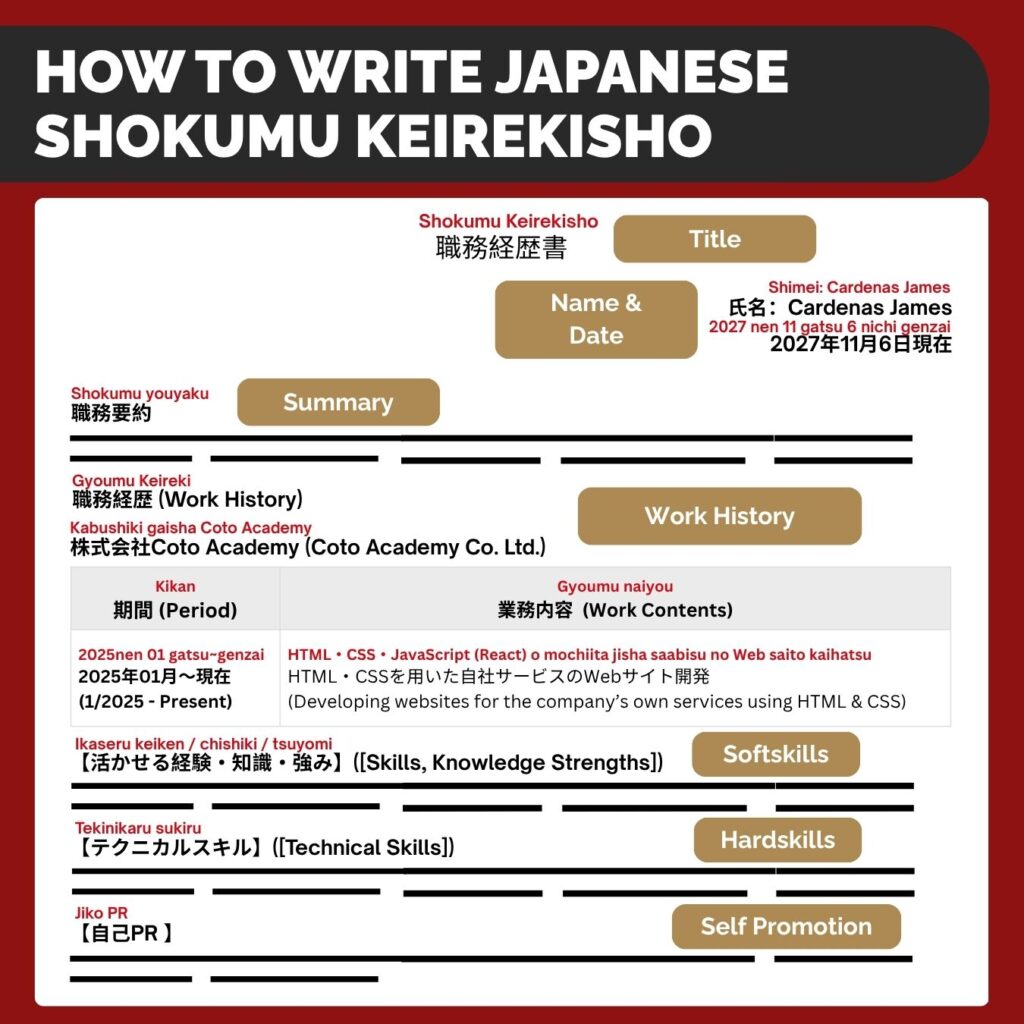
Unlike the rirekisho, the shokumu rirekisho can have a more flexible structure, but generally, you start off by writing a summary of your career and skills. Then you usually create tables breaking down your experience and accomplishments at different companies you have worked in.
Here is a general structure that is common for the shokumu rirekisho:
- Title: Just simply put 職務経歴書 (shokumu keireikisho) or 業務履歴書 (Gyoumu Rerikisho) centered at the very top
- Name/Date: under the title, include your name and date, which is usually aligned to the right
- Introduction/Summary: a brief summary of your general work experience and skills that you have gained
- Work Experience: the largest part of your CV; includes every company you have worked in and highlights accomplishments and main activities
- Key Strengths and Knowledge: discuss your strengths and soft skills in an easy-to-read format like bullet points
- Skills: Highlight your technical abilities like software skills or programming language proficiency
You don’t need to follow a strict format. You can make a CV that starts off with your most recent work experience or one that follows a chronological timeline starting with your first company. Some companies may prefer the latter to see your chronological career progression. But if you want to emphasize your most recent experience, you can choose to start with that instead.
The most important point is that your shokumu rirekisho is easy to read and understand. It should be organized and clearly show your work experience and skills. So, let’s break down, section by section, how to write your shokumu rirekisho.
1. Introduction: Writing a Personal Summary for the Gyomu Rirekisho / Shokumu Keirekisho
The introduction is pretty straightforward; you just write a quick overview of your skills and experience. It’s similar to writing an introduction for a Western-style resume. It doesn’t need to be too long; you usually write around 3 to 5 lines to briefly summarize your whole career and give hiring managers a general idea of your professional background.
You don’t need to go into too much detail, since the rest of the resume will cover the specifics of what you did and your accomplishments at each job.
Example:
Japanese:
【職務要約】
大学卒業後、Web制作会社にてWebデザイナーとして約3年間、企業向けWebサイトのデザイン制作に従事しました。その後、株式会社Coto Academyにてフロントエンドエンジニアとして、HTML・CSS・JavaScript(React)を用いた自社サービスのWebサイト開発を担当しております。デザインと開発の両方の経験を活かし、ユーザーにとって使いやすいWebサイトの制作に貢献したいと考えております。
Romaji:
(Shokumu Youyaku)
Daigaku sotsugyou go, Web seisaku gaisha nite Web dezainaa to shite yaku sannen kan, kigyou muke Web saito no dezain seisaku ni juuji shimashita. Sono go, kabushikigaisha Coto Academy nite furontoendo enjinia to shite, HTML・CSS・JavaScript (React) o mochiita jisha saabisu no Web saito kaihatsu o tantou shite orimasu. Dezain to kaihatsu no ryouhou no keiken o ikashi, yuuzaa ni totte tsukaiyasui Web saito no seisaku ni kouken shitai to kangaete orimasu.
English:
Career Summary
After graduating from university, I worked for about 3 years as a web designer at a web production company, designing websites for corporate clients. I’m currently working at Coto Academy Co., Ltd. as a front-end engineer, developing websites for the company’s own services using HTML, CSS, and JavaScript (React). I hope to use my experience in both design and development to help create websites that are easy for users to use.
2. Writing Work Experience on the Gyomu Rirekisho / Shokumu Keirekisho
This is the largest part of the shokumu rirekisho since you will need to list each company for which you worked, describe your main activities, and highlight your achievements. It’s common to make a table with two columns: the left column shows your start & end dates; the right column will detail your main areas of work and greatest achievements.
Generally, each section corresponds to each company you have worked for. As mentioned, there is no fixed format or template you have to follow, but it should be very organized and easy to understand. But you usually include specific information, including:
- 期間 (kikan): Time period you worked at the company
- 業務内容 (gyoumu naiyou): Business/work content
- 実績 (jisseki): Achievements
It might also be useful to include the industry of each company, especially if you worked in companies in different industries throughout your career. Some people also include information about their company, like the number of employees or annual profits. Its also common to include your type of employment contract at each company, but it’s not necessary.
Example:
Japanese:
株式会社Coto Academy
| 期間 | 業務内容 |
| 20XX年XX月〜現在 | 【業務内容】HTML・CSS・JavaScript(React)を用いた自社サービスのWebサイト開発Figmaを用いたUI/UXデザインの設計およびプロトタイプの作成WordPressを用いたコーポレートサイトの構築・運用 【使用技術】HTML / CSS / JavaScript(React)、WordPress、Figma 【実績】サイトリニューアル案件を10件以上担当ページ表示速度の改善により、直帰率を20%改善スマートフォン対応の強化により、モバイル経由の問い合わせ数を15%増加 |
Romaji:
Kabushiki gaisha Coto Academy
| Kikan | Gyoumu naiyou |
| 20XXnenXXgatsu〜20XXnenXXgatsu | [Gyoumu Naiyou]HTML・CSS・JavaScript (React) o mochiita jisha saabisu no Web saito kaihatsu Figma o mochiita UI/UX dezain no sekkei oyobi purototaipu no sakusei WordPress o mochiita koporeeto saito no kouchiku・unyou [Shiyou Gijutsu]HTML / CSS / JavaScript (React), WordPress, Figma [Jisseki]Saito rinyuuaru anken o juukken ijou tantouPeeji hyouji sokudo no kaizen ni yori, chokkiritsu o nijuppaasento kaizenSumaatofon taiou no kyouka ni yori, mobairu keiyu no toiawase suu o juugo paasento zouka |
English:
Coto Academy Co., Ltd.
| Period | Job Description |
| Month/Year XX, 20XX – Present | [Job Description]・Developing websites for the company’s own services using HTML, CSS, and JavaScript (React)・Designing UI/UX and creating prototypes using Figma・Building and managing corporate websites using WordPress [Technologies Used]・HTML / CSS / JavaScript (React), WordPress, Figma [Achievements]・Handled more than 10 website redesign projects・Reduced bounce rate by 20% by improving page loading speed・Increased inquiries coming from mobile by 15% by strengthening mobile support |
If you’re not sure what to write for your achievements, try using numbers whenever you can. Figures like percentages, rankings, or the number of projects you handled make your experience easier to understand at a glance.
3. Key Strengths and Knowledge on Shokumu Keirekisho
This section is your chance to show what you’re good at beyond your job titles. Instead of repeating your work history, highlight the strengths and knowledge you built across your career, and back them up with a short example. It’s usually written as bullet points so hiring managers can scan it quickly, and many people limit it to 3 to 5 points.
Example:
Japanese:
【活かせる経験・知識・強み】
- Web開発力:HTML・CSS・JavaScriptを用いたフロントエンド開発の経験があり、保守しやすいコードを意識して開発してきました。
- デザイン力:Figmaを用いて、ユーザーの使いやすさを考えたUI設計を行ってきました。
- コミュニケーション力:日英バイリンガルとして、デザイナー・エンジニア・クライアントの間で円滑に調整を行ってきました。
- 課題解決力:アクセス解析のデータをもとにサイトの課題を見つけ、改善を提案してきました。
Romaji:
(Ikaseru keiken・chishiki・tsuyomi)
- Web kaihatsuryoku: HTML, CSS, JavaScript o mochiita furontoendo kaihatsu no keiken ga ari, hoshu shiyasui koodo o ishiki shite kaihatsu shite kimashita.
- Dezainryoku: Figma o mochiite, yuuzaa no tsukaiyasusa o kangaeta UI sekkei o okonatte kimashita.
- Komyunikeeshonryoku: Nichi-Ei bairinguru toshite, dezainaa, enjinia, kuraianto no aida de enkatsu ni chousei o okonatte kimashita.
- Kadai kaiketsuryoku: Akusesu kaiseki no deeta o moto ni saito no kadai o mitsuke, kaizen o teian shite kimashita.
English:
Strengths and knowledge I can bring:
- Web development: I have front-end development experience with HTML, CSS, and JavaScript, and I write code that’s easy to maintain.
- Design: I’ve designed UIs in Figma with ease of use in mind.
- Communication: As a Japanese-English bilingual, I’ve coordinated smoothly between designers, engineers, and clients.
- Problem solving: I’ve found issues on sites using analytics data and suggested improvements
4. Technical Skills on the Shokumu Rirekisho
The last section is where you list your technical abilities, such as software, tools, programming languages, and language proficiency. A simple table or bullet list works best, since it’s easy to scan. Include how well you can use each one, even briefly, so employers know how you’ve used them in a work setting. Be honest, though, since interviewers often ask follow-up questions about what you list here.
Example:
Japanese:
【テクニカルスキル】
- プログラミング言語:HTML・CSS・JavaScript(3年)、PHP(1年)
- ライブラリ:React、jQuery
- デザインツール:Figma、Adobe Photoshop、Illustrator
- CMS:WordPress
- その他:Git、Google Analytics
- 語学:日本語(ビジネスレベル・JLPT N2取得)、英語(ネイティブレベル
Romaji:
(Tekunikaru sukiru)
- Puroguramingu gengo: HTML, CSS, JavaScript (sannen), PHP (ichinen)
- Raiburari: React, jQuery
- Dezain tsuuru: Figma, Adobe Photoshop, Illustrator
- CMS: WordPress
- Sonota: Git, Google Analytics
- Gogaku: Nihongo (bijinesu reberu・JLPT N2 shutoku), Eigo (neitibu reberu)
English:
Technical skills:
- Programming languages: HTML, CSS, JavaScript (3 years), PHP (1 year)
- Libraries: React, jQuery
- Design tools: Figma, Adobe Photoshop, Illustrator
- CMS: WordPress
- Other: Git, Google Analytics
- Languages: Japanese (business level, JLPT N2 obtained), English (native level)
5. Self PR and Motivation on Shokumu Keirekisho
Known in Japanese as 自己PR (jiko PR), this section is pretty self-explanatory, you just promote why you’re a great choice for the company and your motivation for applying. Similar to a cover letter, you should try to understand the job description and company you are applying to. You should try to tailor your skill set and experience to the role while also giving intrinsic motivation for why you are applying to the company.
Example:
Japanese:
【自己PR・志望動機】
私の強みは、ユーザーの使いやすさを第一に考えたWebサイトの設計・開発力です。現職では、HTML・CSS・JavaScriptを用いたWebサイトの制作と、Figmaを用いたデザイン設計を担当し、10件以上のサイトのリニューアルに携わりました。また、ページの表示速度とスマートフォン表示の改善に取り組んだ結果、サイトの直帰率を20%改善することができました。貴社が「〇〇」という理念のもと、使いやすさにこだわったサービスを提供されている点に強く共感し、志望いたしました。現職で培ったWeb開発力とデザイン力に加え、日英バイリンガルとして海外のお客様向けのサイト制作にも対応できる強みを活かし、貴社サービスの価値向上に貢献したいと考えております。
Romaji:
(Jiko PR / Shibou Douki)
Watashi no tsuyomi wa, yuuzaa no tsukaiyasusa o daiichi ni kangaeta Web saito no sekkei・kaihatsuryoku desu. Genshoku de wa, HTML, CSS, JavaScript o mochiita Web saito no seisaku to, Figma o mochiita dezain sekkei o tantou shi, juukken ijou no saito no rinyuuaru ni kakawarimashita. Mata, peeji no hyouji sokudo to sumaatofon hyouji no kaizen ni torikunda kekka, saito no chokkiritsu o nijuppaasento kaizen suru koto ga dekimashita. Kisha ga “〇〇” to iu rinen no moto, tsukaiyasusa ni kodawatta saabisu o teikyou sarete iru ten ni tsuyoku kyoukan shi, shibou itashimashita. Genshoku de tsuchikatta Web kaihatsuryoku to dezain-ryoku ni kuwae, Nichi-Ei bairinguru toshite kaigai no okyakusama muke no saito seisaku ni mo taiou dekiru tsuyomi o ikashi, kisha saabisu no kachi koujou ni kouken shitai to kangaete orimasu.
English:
Self-PR and Motivation
My strength is designing and developing websites with ease of use as the top priority. In my current role, I build websites with HTML, CSS, and JavaScript and handle design work in Figma, and I’ve been involved in redesigning more than 10 sites. I also worked on improving page loading speed and mobile display, which lowered the site’s bounce rate by 20%. I was drawn to apply because I strongly relate to your company’s philosophy of “〇〇” and your focus on creating easy-to-use services. In addition to the web development and design skills I’ve built in my current role, I hope to use my strength as a Japanese-English bilingual who can also build sites for overseas customers to help increase the value of your services.
Conclusion: Writing a Gyomu Rirekisho / Shokumu Keirekisho is Similar to a Resume
Like a Western resume, the gyomu rirekisho/shokumu keirekisho focuses on your work experience rather than your academic background. This is what makes it different from the standard Japanese rirekisho and why it’s ideal for those applying for jobs mid-career. There also isn’t a strict format or template you have to follow, so you can be flexible with how you write it, but most importantly, be sure it’s easy to read and sufficiently shows your skills and who you are as a professional!
If your documents pass screening, you will need to prepare for the interview! To find out the most common questions and answers, check out our guide: 14 Most Useful Japanese Job Interview Phrases
Prepare for a Career in Japan with Coto Institute!
If you are thinking of building a career in Japan, Coto Institute is the perfect place to start. We can sponsor student visas, allowing students to study Japanese full-time. Our Japanese classes are designed to help you develop natural speaking, reading, and writing skills for everyday life and professional settings in Japan. On top of that, we provide job hunting support from drafting your gyomu rirekisho to interview preparation!
If you are ready to sign up or just want to have a casual chat for more details, fill out the form below, and we will be in touch with you as soon as possible!
Shokumu Keirekisho FAQ:
What is a shokumu keirekisho (職務経歴書)?
It’s a Japanese career resume that focuses on your work experience, achievements, and skills. It’s used when changing jobs (転職, tenshoku) and is usually submitted alongside your rirekisho. 業務履歴書 (gyoumu rirekisho) is another name for it, though 職務経歴書 is the more common term.
What’s the difference between a rirekisho and a shokumu keirekisho?
A rirekisho follows a set template and focuses on your personal details, education, and basic work history. A shokumu keirekisho has a flexible format and goes into detail about what you did at each company and what you achieved.
Do I need both a rirekisho and shokumu keirekisho when applying for a job in Japan?
Most companies ask for both when you’re changing jobs. If you’re a fresh graduate with no work experience, a rirekisho is usually enough.
How long should a shokumu keirekisho be?
It’s typically around 2 pages of A4 paper. Keep it clear and easy to scan, and focus on the experience most relevant to the job.