




If you are planning to study at a Japanese language school, one of the most confusing parts of the application process is the Certificate of Eligibility (COE). The COE is an official document issued by Japanese immigration authorities that serves as a form of pre-screening for long-term visa applicants. Without it, obtaining a student visa for Japan can be extremely difficult.
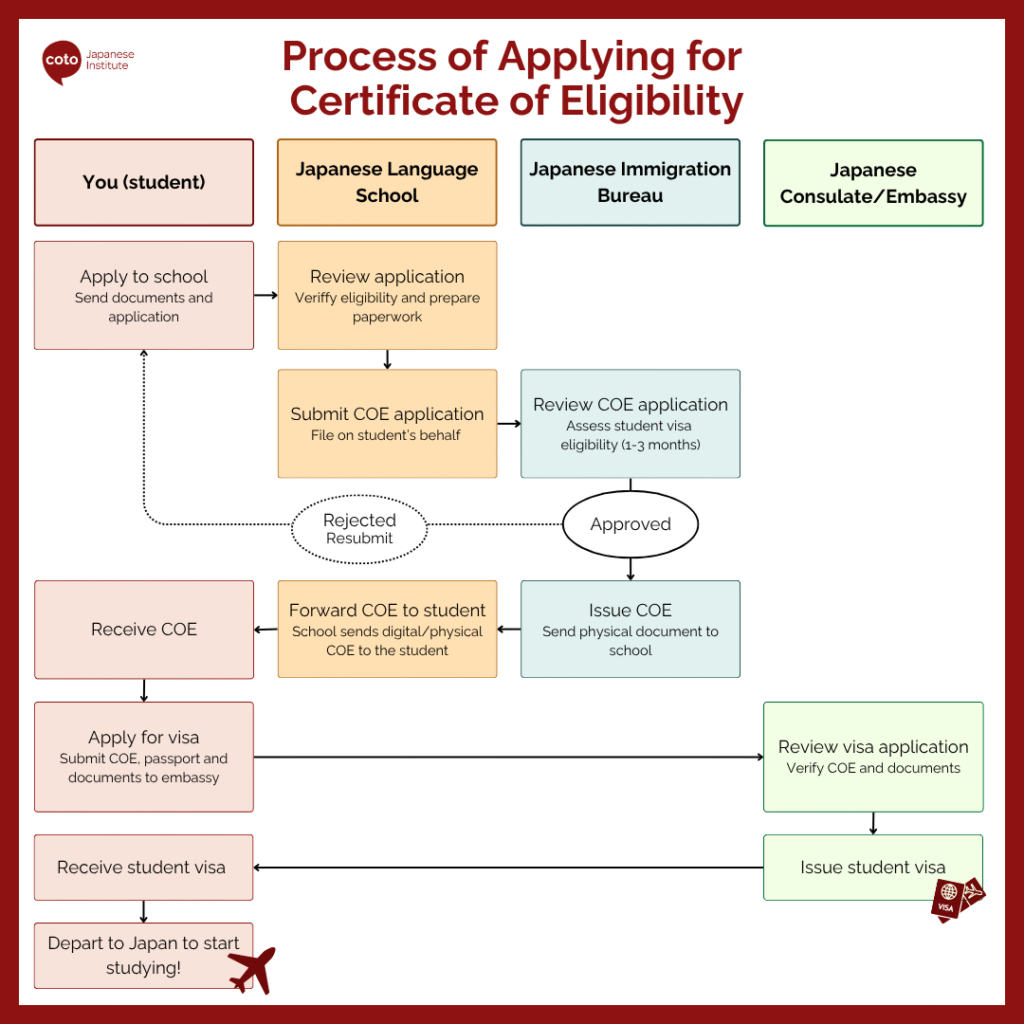
Many students assume that the visa application is the first step. In reality, obtaining a COE comes before applying for the visa itself. Most Japanese language schools that advertise student visa sponsorship, such as Coto Japanese Institute, are actually referring to COE sponsorship. This means the school submits the COE application to immigration on your behalf. Once the COE is issued, you can then use it to apply for your student visa at a Japanese embassy or consulate in your home country.
In this blog, we’ll explain what the COE is, why it is important, and the documents you will typically need to prepare for your application.
What is a COE?
A Certificate of Eligibility is a document that is required for all Japanese visa applications and is issued by Japanese immigration authorities.
Receiving a COE confirms that the applicant meets the conditions for entering Japan under a specific visa category. For prospective student visa holders, you will need to satisfy certain conditions, such as meeting a 150-hour Japanese study requirement, in order to apply for a Certificate of Eligibility.
This document is issued before the visa application and does NOT constitute the visa itself upon receiving it. It is used to simplify visa application processing at your local Japanese embassy or consulate.
If you are thinking about studying Japanese in Japan, consider applying to Coto Japanese Institute. As a Japanese language school that also operates a short-term Japanese language school, Coto Academy, Coto’s staff can help guide you through the student visa process, including meeting the 150-hour Japanese study requirement often needed for a COE application!
Want to study Japanese with us?
Why is the COE required for a Japanese student visa?
There are a few reasons why the COE is required for a Japanese student visa. One reason is that a visa is required for long-term stays of more than 90 days in Japan, and student visas are no exception. Because the COE application screens applicants entering Japan for the first time, they will be more cautious in their screening. In this case, Japan will screen the following to determine whether an applicant is eligible for a COE:
- Financial capability: to see whether an applicant has sufficient funds to support their studies in Japan.
- School enrollment legitimacy: to see whether an applicant is actually enrolled in a Japanese educational institution.
- Study intentions: This is to see whether the applicant actually intends to study at that educational institution.
- Sponsor details: They also want to know the legitimacy of an applicant’s sponsor.
In addition, Japanese embassies process visa applications more smoothly with an approved COE, making the transition from your home country to Japan smoother.
Furthermore, a COE is required to reduce fraudulent enrollments at Japanese institutions and visa misuse upon arrival in Japan.
Who applies for the COE?
While it may seem you need to apply for the COE yourself, the accepting organization usually applies on your behalf. In the case of student visas, your school in Japan, whether it is a language school, university, or vocational school, will apply for the COE for you. However, you will still need to submit the required documents set by the school, provide financial proof, and complete the school forms accurately.
For example, when you decide to enroll at Coto Japanese Institute, you will submit the required documents to our admissions team. We will then apply for the Certificate of Eligibility (COE) on your behalf. Once the COE is issued by Japanese immigration authorities, we will send the document to you so you can use it to apply for your student visa at the Japanese embassy or consulate in your home country.
Documents required for the COE
Here is a general list of documents that you will need to prepare for a COE application. We recommend that you talk to our admission team directly so you have a better idea of what things you should have.
Personal documents
These are documents that are necessary for all COE applications. They include:
- A copy of your passport: This also includes not only the identification page, but also recent travel history to Japan (if applicable).
- Passport-sized photos
- Application forms: Some educational institutions require you to fill out an application form.
- Educational transcripts/certificates/diplomas: Depending on which educational institution you apply to, some schools may require high school transcripts or university diplomas. In addition, you will also need to show proof of 150 hours of Japanese language study for prospective student visa applicants.
Financial Documents
Some common documents that you can use to prove this financial support include bank statements, proof of sponsor income, and scholarship documents. Either way, you will need to show that you have enough funds to support your studies in Japan.
Additional Supporting Documents
While these aren’t completely necessary, these documents can help support your application and increase your chances of obtaining the COE:
- Statement of purpose: This is a letter stating your intentions to study in Japan and what your plans are after you complete your studies.
- Proof of sponsor relationship: Especially if your financial sponsor is a family member, you might want to consider including a document proving your relationship with them, such as a birth certificate.
- Tuberculosis Screening: Depending on your nationality, you might have to undergo a tuberculosis screening at a designated panel clinic.
A step-by-step guide on obtaining a COE for student visas
Step 1: Apply to a Japanese School
The first step in the application process is to apply to a Japanese educational institution. Each school has its own set of requirements that an applicant will need to satisfy before they can be accepted. For example, in order to enroll at the Coto Japanese Institute, you will not only need to fulfill the language study requirement of 150 hours of Japanese language study, but you will also need to prove that you have a bachelor’s degree or higher.
Step 2: Submit COE Documents
If you manage to receive an acceptance letter to the school, the next thing you will need to do is to submit the required documents for your COE application. As mentioned before, the school is usually the one to apply for the COE on your behalf, so all you need to do is send the documents required to them.
Step 3: School applies to immigration
The school in Japan will then submit your documents and the COE application to the Regional Immigration Bureau in Japan.
Step 4: Immigration reviews the application
The Immigration Bureau in Japan will then screen the application. However, the processing time it will take for immigration to process your application can vary, but generally, it will take about one to three months for the application to be processed.
Step 5: COE gets issued
If there are no problems with the application, the COE will be issued between one and three months after the application is submitted. The original or a digital copy of the COE will be sent to you, and once you receive that, you can now apply for a student visa.
How long does the COE process take?
Typically, it takes about one to three months for the COE application to be processed; however, processing times can take longer due to a variety of factors.
For example, depending on how much workload the Immigration Bureau gets, your COE application might take some time to process. Heavy immigration workloads can potentially cause a backlog in application processing, especially during peak intake seasons such as April and October, when Japanese language schools begin their new terms. As such, it is recommended that you apply to your school of choice early and that you submit your documents as soon as possible when you receive your acceptance letter.
The applicant’s nationality can also be a factor in how long the Immigration Bureau will take to process your application. Depending on which country’s passport you have, your COE application might take longer compared to other nationalities.
Common reasons why your COE application might be delayed or rejected
Being accepted into a Japanese language school does not automatically guarantee approval of your Certificate of Eligibility (COE) or student visa, as the final decision is made by the Japanese Immigration Bureau.
There are cases where a COE application may be rejected. In the past, Coto School Finder — our Japanese study abroad support service — has helped students reapply for a COE for a later intake term and successfully receive approval. Don’t give up!
Although immigration authorities generally do not disclose the exact reason for a rejection, some common reasons why a COE application may be denied include:
1. Incomplete documentation
Incomplete documentation can reduce your chances of obtaining a COE. For example, missing bank statements or even incomplete application forms can affect your chances of getting a COE, as the Immigration Bureau may ask for additional documents, delaying the application process even further. Your application might be rejected as well. To avoid this, make sure to submit all necessary documents on time and complete all application forms accurately.
2. Weak Financial Proof
Although you can submit your own bank statements to immigration, insufficient savings or unclear financial sponsorship can reduce your chances of receiving a Certificate of Eligibility (COE).
Immigration authorities may also look for inconsistencies in your financial documents.
For example, many schools expect applicants or sponsors to show around 2–3 million Japanese yen in savings to demonstrate financial stability during their studies in Japan.
At the same time, sudden large changes in account balances can raise concerns. For instance, if a bank account balance went from nearly zero to 3 million yen within a short period in a one-year bank statement history, immigration authorities may question the source and stability of those funds. Your bank statements should demonstrate consistent and reliable financial support rather than temporary deposits made solely for the application
2. Inconsistent Information
Having inconsistent information filled out on your application form can cause delays in processing or even outright rejection. Make sure that the information you have filled out on the application form matches the documents that you have submitted.
3. Gaps in your education/work history
Having gaps in your education or work history does not automatically mean your COE will be rejected. However, immigration may ask for additional clarification, especially if there are long periods where you were not studying or working.
The important thing is to provide a clear and honest explanation. For example, you may have spent time improving your language skills, caring for family members, preparing for future studies, or exploring career options. These are all understandable situations, as long as they are explained properly in your application.
It’s also important to remember that there is no strict age limit for studying Japanese in Japan. At Coto Japanese Institute, many students are working professionals or people who have already completed a master’s degree or PhD before deciding to study Japanese!
4. Poor Immigration History
Previous immigration or visa issues can also affect your chances of getting a COE approved by the Japanese Immigration Bureau. This may include past visa rejections, overstays, deportation records, or even poor attendance records during previous studies abroad.
If you have any immigration history that could affect your application, we strongly encourage you to be open with the admissions team. For example, if you have previously been denied a visa, detained at immigration, or refused entry at an airport, sharing this information early allows the school to better advise you on how to prepare your application.
What happens next after receiving the COE?
If you manage to receive your COE, you will need to bring it to the embassy to have it processed into a student visa. Along with your COE, you will also need to bring the following documents:
- Your passport
- A visa application form
- A recent passport-sized photo of yourself
- Any additional documents required by the embassy
Remember, the COE expires 3 months from the designated day you’re supposed to enter Japan, so be sure to apply for the visa as soon as possible. Standard processing times for visa applications can last for about five business days, provided that there are no problems with the contents of your application. Should you have a valid COE and no issues with your visa application, processing will proceed smoothly, and you will eventually receive your student visa.
Is the COE a guaranteed visa approval?
In short, no. Having a COE doesn’t guarantee that you’ll get the student visa, as final review will always depend on a review from your local Japanese embassy. However, having a valid COE will significantly increase your chances of getting the student visa.
Conclusion: Obtaining a COE doesn’t have to be hard (and daunting!)
While it may seem difficult to obtain a COE, filling out the forms correctly and submitting the right documents will increase your chances of getting this document. Once you obtain the COE, your chances of obtaining a student visa will significantly increase, and before you know it, you’ll get your student visa, and you’ll be ready to start your studies in Japan!
Want to study Japanese with us?
Still choosing which Japanese language school to study at? Why not come study with us? As a recent MEXT-approved institution, and with over 25 years of experience in practical Japanese instruction, our 1-year program is tailored towards individuals wanting to learn the language full-time, whether it be for Japanese career opportunities and so forth.
Ready to study with us? We are open for our October and April intakes! Contact us below to get started with your application!
FAQ
Why is a COE necessary for Japanese visa applications?
The process to obtain a COE is basically a pre-screening by the Immigration Bureau to determine whether you can enter Japan for a long-term stay.
What are some of the common reasons a COE application might get rejected?
Some reasons include insufficient proof of funds, poor immigration history, or even submitting fraudulent documents. Make sure to submit the correct documents and fill out the application form correctly!
Can I apply for a Japanese visa without a COE?
Technically, you can, but we strongly recommend that you obtain a COE to significantly increase your chances of obtaining a Japanese visa.
Read more
- Moving to Japan Guide: 30-Day Checklist for Your First Month Here
- 5 Best Japanese Language Schools in West Tokyo